Classical monologues for women: 20 public domain picks
Here are 20 classical monologues for actresses, all free to copy and perform: Shakespeare, Marlowe, Webster, Congreve, Farquhar, Sheridan, Wilde, Shaw, and two old translations of Ibsen and Chekhov. None of these roles appears in our main list of public domain monologues, so you will find other women here than Lady Macbeth, Juliet, Viola or Nora. For each one: the play, the act and scene, an indicative age, an estimated length, the opening words and a link to the full text on Project Gutenberg. We do not reprint the speeches.
In brief
- Choose a role close to your own age and casting first, then the length: most audition speeches are asked to run under two or three minutes.
- Read the whole play before you work the speech: who is she talking to, what does she want from them, and what has just happened to her?
- Lengths are word counts in the linked text divided by 140 words a minute. Verse and pauses run slower: time yourself out loud, your pace is the one that counts.
- Prepare two contrasting speeches, verse and prose or serious and comic: many panels ask for a second one.
Choosing a classical monologue as a woman
The classical repertoire has fewer long speeches for women than for men, and the same handful come back at every audition: Lady Macbeth's letter scene, Juliet's "Gallop apace", Viola's ring speech, Helena, Hermione. A panel hearing its tenth Viola of the day listens less well. The twenty roles below are played less often, but every one of them is a woman who wants something and says so.
- Casting before prestige. A 25-year-old playing Volumnia has to age thirty years, and the panel mostly sees the effort. Pick a role within five or ten years of your real age.
- Someone to talk to. A speech aimed at one person (Lady Percy at her father-in-law, Mrs Cheveley at Sir Robert) plays better than a general reflection: place your imaginary partner and talk to them.
- A change inside the speech. A good audition speech takes the character from one state to another: from courtesy to attack, from fear to a decision.
- Verse or prose. Shakespearean verse shows your technique (breath, line endings, the shape of an argument); Restoration and Wilde prose shows your timing and lightness. If you bring only one speech, choose the form you are most at ease in.
- The rules. Time limit, number of speeches, period or style required: read the audition notice before you choose. Speeches marked "cut" run past two and a half minutes.
The list: 20 roles for women
For each speech: play (act, scene), character, indicative age, length and estimated time, situation, opening words, link to the free text. Ages are casting guides, not rules: many of these roles are played across a wider range. Acts and scenes follow the edition linked; other editions sometimes number scenes differently.
Shakespeare: the comedies (died 1616)
- The Merchant of Venice, 4.1 — Portia · 20-30 · verse, about 170 words, 1 min 15 · Disguised as a young doctor of law, she stands in the Venetian court and asks Shylock to show the mercy no law can force on him. Famous, but rarely heard as an argument aimed at one man. · "The quality of mercy is not strain’d" · text (Gutenberg)
- The Taming of the Shrew, 5.2 — Katherina · 25-35 · verse, about 365 words, 2 min 35, cut · Called on by Petruchio to lecture the other wives on what they owe their husbands. Sincere, ironic or strategic: the reading is yours, and the panel will want to see that you made a choice. · "Fie, fie! unknit that threatening unkind brow" · text
- The Comedy of Errors, 2.2 — Adriana · 25-35 · verse, about 290 words, 2 min 05 · In the street, she reproaches the man she takes for her husband for his coldness. It is in fact his twin, which the audience knows and she does not: play her grief completely straight. · "Ay, ay, Antipholus, look strange and frown" · text
- The Merry Wives of Windsor, 2.1 — Mistress Page · 35-50 · prose, about 250 words with the letter, 1 min 45 · She reads aloud the love letter Falstaff has sent her, mocks the old knight's nerve and swears revenge. One of the few comic speeches for a woman over thirty-five. · "What, have I scaped love-letters in the holiday-time of my beauty" · text
Shakespeare: histories and tragedies
- Henry VIII, 2.4 — Queen Katherine · 40-55 · verse, about 365 words, 2 min 35, cut · Summoned to the court at Blackfriars where her marriage is on trial, she kneels at the King's feet and reminds him that she is a stranger in his country and has been his obedient wife for over twenty years. · "Sir, I desire you do me right and justice" · text
- Richard III, 4.4 — Queen Margaret · 55-70 · verse, about 285 words, 2 min 05 · The old queen faces Queen Elizabeth, now as bereaved as she once was, and lists everything her rival has lost: husband, brothers, sons, crown. Bitter, precise, almost joyful. · "I called thee then, vain flourish of my fortune" · text
- Henry IV, Part 2, 2.3 — Lady Percy · 20-35 · verse, about 295 words, 2 min 05 · Hotspur's widow begs her father-in-law not to join the rebels now, when he failed to come to the battle where her husband died. Grief turned into an accusation. · "O yet, for God’s sake, go not to these wars!" · text
- Coriolanus, 5.3 — Volumnia · 50-65 · verse, about 260 words, 1 min 50 · In the enemy camp, she pleads with her son not to march on Rome: whatever he chooses, his mother loses. Her plea goes on in a second, longer speech in the same scene. · "Should we be silent and not speak, our raiment" · text
- Antony and Cleopatra, 5.2 — Cleopatra · 35-45 · verse, about 155 words, 1 min 05 · Antony is dead and Caesar means to parade her through Rome; she has her women dress her as a queen for her death. Short, regal, and calm rather than tragic. · "Give me my robe. Put on my crown." · text
Marlowe (died 1593) and Webster (died around 1634)
- Christopher Marlowe, Tamburlaine the Great, Part 1, Act 5 — Zenocrate · 20-30 · verse, about 185 words, 1 min 20 · Betrothed to the conqueror, she sees the city of Damascus slaughtered at his order and cannot reconcile her love with what he has done. The linked edition prints Act 5 as one scene; remove the bracketed note numbers. · "Wretched Zenocrate! that liv’st to see" · text
- John Webster, The White Devil, 4.2 — Vittoria Corombona · 25-35 · verse, about 180 words, 1 min 15 · Locked in a house of penitents after her trial, she turns on her lover, Duke Brachiano, who has just raged at her over a forged love letter, and throws his gifts back at him. · "What have I gain’d by thee, but infamy?" · text
Restoration and eighteenth-century comedy
- William Congreve (died 1729), The Way of the World, Act 4 — Millamant · 20-30 · prose, about 385 words without Mirabell's lines, 2 min 45, cut · The "proviso scene": on the verge of marriage, she sets out the conditions on which she might "dwindle into a wife". Remove Mirabell's short interjections to make one speech. · "Ah, don’t be impertinent. My dear liberty, shall I leave thee?" · text (scene 5 of Act 4 in this edition)
- George Farquhar (died 1707), The Beaux' Stratagem, 2.1 — Mrs Sullen · 25-35 · prose, about 200 words, 1 min 25 · To her sister-in-law, a London wife buried in the country describes her drunken husband's arrival in bed at four in the morning. Comedy built on real despair. · "O sister, sister! if ever you marry, beware of" · text
- R. B. Sheridan (died 1816), The School for Scandal, 4.3 — Lady Teazle · 20-30 · prose, two speeches, about 150 words, 1 min 05 · Found hiding behind the screen in Joseph Surface's library, she refuses his excuses and tells her husband the truth. Cut the two short lines between her speeches. · "Hear me Sir Peter" · text
Wilde (died 1900) and Shaw (died 1950)
- Oscar Wilde, Lady Windermere's Fan, Act 3 — Mrs Erlynne · 35-45 · prose, about 375 words, 2 min 40, cut · In Lord Darlington's rooms, the woman with a past begs Lady Windermere, who does not know she is her daughter, to go home to her husband before she is ruined. · "Believe what you choose about me." · text
- Oscar Wilde, An Ideal Husband, Act 1 — Mrs Cheveley · 30-45 · prose, about 340 words, 2 min 25 · She tells Sir Robert Chiltern exactly what will happen to him if the letter proving he sold a Cabinet secret is published. Blackmail delivered as social comedy. · "My dear Sir Robert, what then?" · text
- George Bernard Shaw, Candida, Act 3 — Candida · 30-40 · prose, about 330 words, 2 min 20 · Asked to choose between her husband and the young poet, she explains what it has cost her to keep her husband strong, clever and happy. Warm, ironic, and in complete control. · "Never mind that just at present." · text
- George Bernard Shaw, Pygmalion, Act 5 — Eliza Doolittle · 20-30 · prose, about 165 words, 1 min 10 · When Higgins grabs her for threatening to teach his methods to a rival, she realises he can no longer frighten her. Start at "Wring away"; Higgins's lines and the stage directions come out. · "Wring away. What do I care?" · text
Two old translations
- Henrik Ibsen (died 1906), Ghosts, Act 2 — Mrs Alving · 45-55 · prose, about 125 words, 55 s · To Pastor Manders, she explains why she is afraid: not only of what parents pass on, but of the dead ideas that "walk" in all of us. Translation by William Archer (died 1924). · "Ghosts! When I heard Regina and Oswald in there" · text
- Anton Chekhov (died 1904), The Cherry Orchard, Act 2 — Lubov Andreyevna Ranevsky · 40-50 · prose, about 235 words, 1 min 40 · In a field near the estate, close on sunset, she confesses her life: the money thrown away, the drowned son, the lover in Paris who still sends telegrams. Translation by Julius West (died 1918). · "Oh, my sins...." · text (Plays by Chekhov, Second Series)
By age and length: the quick sort
- 20 to 30, under 1 min 30: Portia, Zenocrate, Lady Teazle, Eliza; Vittoria and Mrs Sullen up to 35.
- 20 to 35, 1 min 30 to 2 min 45: Lady Percy, Adriana; Millamant and Katherina once cut.
- 30 to 45: Cleopatra, Mrs Cheveley, Candida, Mrs Erlynne (to cut).
- 40 and over: Mistress Page, Queen Katherine (to cut), Mrs Alving, Ranevsky, Volumnia, Queen Margaret.
- Comic or ironic: Mistress Page, Millamant, Mrs Sullen, Mrs Cheveley, Eliza.
Cutting a speech that runs too long
Katherina, Queen Katherine, Millamant and Mrs Erlynne run past two and a half minutes, and Shakespeare's verse often runs slower than our estimate. Cutting them is not betraying the text, as long as you follow three rules:
- Keep one movement: a starting situation, an intention, a change. With Queen Katherine, for example, keep either her account of her years as a wife or her demand for time to consult her friends in Spain, not both.
- Cut at the end of a sentence, never in the middle of a verse line, and never rewrite a word. When you join two speeches (Millamant, Lady Teazle), check that the join still makes sense without the other character's line.
- Write down your cut (first and last line): a panel may ask where your passage starts.
For the complete method, from first reading to secure words, see our audition monologue practice guide. For the wider plan, from reading each school's guidance to the day itself, see how to prepare for a drama school audition.
Why these texts are free
In the UK and the EU, an author's rights last 70 years after their death; in the United States, a work first published before 1929 is in the public domain. Every author on this list died before 1956, and every play was published before 1929: the most recent author here, Bernard Shaw, died in 1950. For a translation, the translator's own death date is what counts: William Archer died in 1924 and Julius West in 1918, so their versions are free; a recent translation of Ibsen or Chekhov is still protected. A modern edition's notes, cuts and layout can be protected too; the older editions transcribed on Project Gutenberg do not have that problem. Rules differ by country, and this page is not legal advice.
Looking for more? Our main list of public domain audition monologues, by age and length has 39 more, including Lady Macbeth, Juliet, Viola, Rosalind, Hermione, Lady Windermere, Nora and Mrs Warren.
Rehearse it in MasteringTheatre
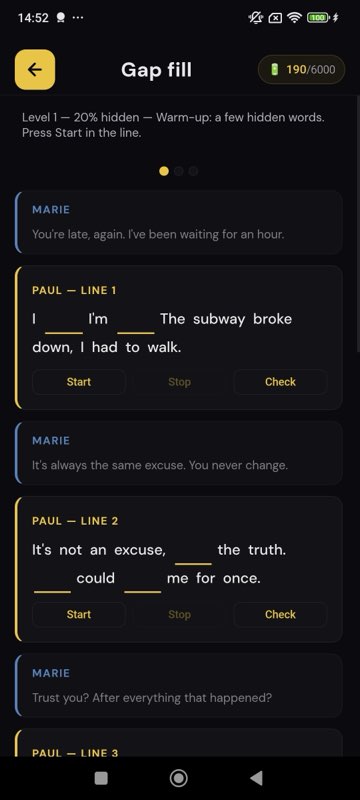
The app does not contain these texts: you copy the speech from the link, without line numbers or notes, and paste it into the app in NAME: line format, one beat per line, each starting with the character's name in capitals (PORTIA: The quality of mercy is not strain’d,). Each line becomes a line the app waits for and scores: green from 85 %, gold from 70 %, red below; the words you missed or changed only appear in the review, once the speech is finished. On the free plan you rehearse in Step-by-step mode (you validate each line), with the phone's voice and a 5,000-character limit per import, enough for every speech on this page. Fluid mode, which moves on by itself after a silence you set between 0.5 and 10 seconds, is for the Pro and Premium plans. To hide the text step by step, memorisation masks 20 %, 50 % then 80 % of your words: level 1 is free, levels 1 to 3 come with Pro and Premium, and none of them uses energy (⚡). To practise the exercise itself, Training Audition (Pro and Premium) generates an original monologue, which uses energy; imported for rehearsal, it is cut into passages of about 45 words. It is a practice text, unpublished: for an audition that asks for a published speech, keep one of the twenty roles above. Set the app language to English (UK or US), since the app listens in its own language. Import the speech, pick your role, rehearse in Step-by-step: it's free, on Android and iPhone.
What the app will not do
- It does not judge your acting: the score measures whether you said the words of the text, not your interpretation, nor the age or casting you put across.
- It does not correct you live: the score comes after each line, the coloured words in the review.
- It does not film you: no self-tape, no video recording.
- One language at a time: it listens in the language set in the app, not the language of the text. English is available on iPhone (5 languages) and Android (10 languages).
Questions actresses ask
Which classical monologue should I choose for a first audition?
A role close to your age, well under the time limit, in a form you are at ease with. For verse, Portia and Cleopatra are short and clear; for prose, Lady Teazle or Eliza leave room to play. Then prepare a contrasting second speech.
Am I allowed to perform these speeches at an audition?
Yes. The authors died more than 70 years ago, the plays were published before 1929, and the two linked translations are by translators who died in 1924 and 1918. A recent translation can still be protected.
Should I learn the speech from the Gutenberg edition?
If the panel does not ask for a particular edition, yes, modernising old spellings if you wish. If a school or director sets an edition, learn that one: punctuation, and sometimes words, change from one edition to another.
Is Shakespeare required for a classical audition?
Not always. Many notices ask for "a classical speech" and accept Jacobean, Restoration or Wilde. When the notice says "Shakespeare" or "verse", choose from the first two groups above.
Are these texts already in the app?
No. MasteringTheatre has no library of plays: you paste the speech in NAME: line format.
Can I rehearse for free?
Yes: the free plan covers Step-by-step rehearsal with the phone's voice, scores, the review and memorisation level 1, without spending energy. Fluid mode needs Pro or Premium.
Sources
Every link, act and scene, situation and opening line was checked against the linked Project Gutenberg text on 21 November 2026. Death dates: Shakespeare 1616, Christopher Marlowe 1593, John Webster around 1634 (the exact date is not recorded), William Congreve 1729, George Farquhar 1707, Richard Brinsley Sheridan 1816, Oscar Wilde 1900, George Bernard Shaw 1950, Henrik Ibsen 1906 (translator William Archer, 1924), Anton Chekhov 1904 (translator Julius West, 1918). Lengths are counted on the linked edition and rounded; times are estimates. Spotted a mistake? Tell us at contact@masteringtheatre.com.
Import one page. Run one line. See a % score.
Free plan, no card. Android (10 languages) and iOS (5 languages). Pro and Premium: monthly, price shown in the store.

This page describes the app as it was on 2026-11-21. A score measures text accuracy, not talent. Published 2026-11-21.