Public domain audition monologues, by age and length
Thirty-nine classical monologues you can download, copy and perform without paying for the text: eighteen by Shakespeare, nine by other English-language playwrights, twelve in translations that are themselves in the public domain. Each entry gives the role, an indicative age, an estimated length, the opening words and a free full text. We do not reprint the speeches; the links do.
Short answer
A monologue is safe to use freely when the author, and the translator for a translated play, died more than 70 years ago and the text was published before 1929. All 39 below pass both tests. Shortest: Mrs. Hale in Trifles, about half a minute. Longest: Cyrano, Hamlet and Faustus, over three minutes.
How we checked “public domain”
Two tests, both required. The author died before 1956, so more than 70 years have passed, the term used in the UK and the EU. The text was first published before 1929, which places it in the public domain in the United States too. For a translated play the same two tests apply to the English translator: Chekhov is long out of copyright, but most Chekhov translations you can buy today are not. That is why this list uses older translations, credited on each row.
The words of the play are free; a modern edition's notes, cuts and layout may not be. Every link goes to a free transcription: Project Gutenberg in most cases, Wikisource or the Monadnock Valley Press otherwise. Rules differ by country, and this page is not legal advice; for a public performance, check with the venue or the competition.
How to read the lengths
Lengths are estimates: word counts of the speech in the linked text, divided by 140 words a minute, an unhurried speaking pace. Verse, pauses and a slow tempo push the real time up. Time yourself out loud before you choose, and check the time limit in the audition notice. Several long speeches are usually cut for auditions; where a speech in the source is broken by another character's short line, the notes below the tables say where to cut.
The 39 monologues
Within each group, shortest first. Ages are the usual casting range, not a rule: play what you can play.
Women, younger (roughly 16 to 30)
| Character, play | Age | Length | Opens with | Free text |
|---|---|---|---|---|
| Isabella, Measure for Measure (Shakespeare), 2.4 | 18–25 | ~1 min (132 words) | “To whom should I complain? Did I tell this…” | Gutenberg |
| Irina, Three Sisters (Anton Chekhov, tr. Julius West, 1916), Act 1 | about 20 | ~1 min (149 words) | “A man must work, toil in the sweat of his brow…” | Gutenberg |
| The Duchess, The Duchess of Malfi (John Webster), Act 1 (wooing Antonio) | 25–35 | ~1 min 15 (167 words) | “Now she pays it. / The misery of us that are born great!” | Gutenberg |
| Antigone, Antigone (Sophocles, tr. Francis Storr, 1912), to Creon | 16–25 | ~1 min 15 (170 words) | “Yea, for these laws were not ordained of Zeus…” | Gutenberg |
| Nora, A Doll's House (Henrik Ibsen, tr. R. Farquharson Sharp, 1910), Act 3 | 25–35 | ~1 min 15 (185 words) | “It is perfectly true, Torvald. When I was at home with papa…” | Gutenberg |
| Viola, Twelfth Night (Shakespeare), 2.2 | 18–25 | ~1 min 30 (207 words) | “I left no ring with her; what means this lady?” | Gutenberg |
| Helena, A Midsummer Night's Dream (Shakespeare), 1.1 | 18–25 | ~1 min 30 (208 words) | “How happy some o'er other some can be!” | Gutenberg |
| Juliet, Romeo and Juliet (Shakespeare), 3.2 | 14–20 | ~1 min 45 (250 words) | “Gallop apace, you fiery-footed steeds, / Towards Phoebus' lodging…” | Gutenberg |
| Rosalind, As You Like It (Shakespeare), 3.5 | 18–25 | ~1 min 45 (252 words) | “And why, I pray you? Who might be your mother…” | Gutenberg |
| Sonya, Uncle Vanya (Anton Chekhov, tr. Marian Fell, 1912), Act 4, final speech | 20–27 | ~2 min (270 words) | “What can we do? We must live our lives.” | Wikisource |
| Lady Windermere, Lady Windermere's Fan (Oscar Wilde), start of Act 3 | 20–28 | ~2 min 15 (310 words) | “Why doesn't he come? This waiting is horrible.” | Gutenberg |
| Nina, The Seagull (Anton Chekhov, tr. Marian Fell, 1912), Act 4 | 20–25 | ~2 min 15 (330 words) | “Why do you say that you have kissed the ground…” | Wikisource |
Women, 30 and over
| Character, play | Age | Length | Opens with | Free text |
|---|---|---|---|---|
| Mrs. Hale, Trifles (Susan Glaspell), near the end | 40–60 | ~30 s (85 words) | “I might have known she needed help!” | Gutenberg |
| Constance, King John (Shakespeare), 3.4 | 30–45 | ~45 s (111 words) | “Grief fills the room up of my absent child…” | Gutenberg |
| Lady Macbeth, Macbeth (Shakespeare), 1.5 | 30–45 | ~1 min (128 words) | “The raven himself is hoarse / That croaks the fatal entrance of Duncan…” | Gutenberg |
| Emilia, Othello (Shakespeare), 4.3 | 30–45 | ~1 min 15 (158 words) | “But I do think it is their husbands' faults…” | Gutenberg |
| Mrs. Malaprop, The Rivals (R. B. Sheridan), 1.2 | 45–65 | ~1 min 15 (180 words) | “Observe me, Sir Anthony. I would by no means wish a daughter…” | Gutenberg |
| Maurya, Riders to the Sea (J. M. Synge), final speeches | 55–75 | ~1 min 15 (180 words) | “They're all gone now, and there isn't anything more the sea…” | Gutenberg |
| Mrs Warren, Mrs. Warren's Profession (George Bernard Shaw), Act 2 | 40–55 | ~1 min 30 (200 words) | “No, you don't. I do. She called herself a widow…” | Gutenberg |
| Hermione, The Winter's Tale (Shakespeare), 3.2 | 25–40 | ~1 min 30 (203 words) | “Sir, spare your threats: / The bug which you would fright me with…” | Gutenberg |
| Medea, Medea (Euripides, tr. E. P. Coleridge, 1891), “Women of Corinth” | 30–45 | ~2 min 45 (395 words) | “From the house I have come forth, Corinthian ladies…” | Wikisource |
| Phaedra, Phaedra (Jean Racine, tr. Robert Bruce Boswell, 1889–90), 1.3, to Oenone | 30–45 | ~2 min 45 (400 words) | “My wound is not so recent. Scarcely had I…” | Gutenberg |
Men, younger (roughly 16 to 35)
| Character, play | Age | Length | Opens with | Free text |
|---|---|---|---|---|
| Jack, The Importance of Being Earnest (Oscar Wilde), Act 1 | 25–32 | ~45 s (114 words) | “My dear Algy, I don't know whether you will be able…” | Gutenberg |
| Edmund, King Lear (Shakespeare), 1.2 | 20–30 | ~1 min 15 (165 words) | “Thou, Nature, art my goddess; to thy law / My services are bound.” | Gutenberg |
| Romeo, Romeo and Juliet (Shakespeare), 2.2 | 16–22 | ~1 min 30 (204 words) | “But soft, what light through yonder window breaks?” | Gutenberg |
| Benedick, Much Ado About Nothing (Shakespeare), 2.3 | 25–40 | ~1 min 45 (260 words) | “This can be no trick: the conference was sadly borne.” | Gutenberg |
| King Henry, Henry V (Shakespeare), 3.1 | 20–30 | ~2 min (273 words) | “Once more unto the breach, dear friends, once more…” | Gutenberg |
| Lance (Launce), The Two Gentlemen of Verona (Shakespeare), 2.3 | 20–40 | ~2 min 30 (340 words) | “Nay, 'twill be this hour ere I have done weeping…” | Gutenberg |
| Hamlet, Hamlet (Shakespeare), 2.2 | 20–35 | ~3 min 30 (475 words) | “O what a rogue and peasant slave am I!” | Gutenberg |
Men, 30 and over
| Character, play | Age | Length | Opens with | Free text |
|---|---|---|---|---|
| Dr Stockmann, An Enemy of the People (Henrik Ibsen, tr. R. Farquharson Sharp, 1911), Act 4, public meeting | 40–55 | ~45 s (93 words) | “The majority never has right on its side. Never, I say!” | Gutenberg |
| Iago, Othello (Shakespeare), 1.3 | 28–40 | ~1 min 15 (187 words) | “Thus do I ever make my fool my purse.” | Gutenberg |
| Cléante, Tartuffe (Molière, tr. Curtis Hidden Page, 1908), Act 1, with Orgon | 35–50 | ~1 min 15 (190 words) | “That is the usual strain of all your kind…” | Gutenberg |
| Prospero, The Tempest (Shakespeare), 5.1 | 50+ | ~1 min 30 (201 words) | “Ye elves of hills, brooks, standing lakes, and groves…” | Gutenberg |
| Volpone, Volpone (Ben Jonson), 1.1, opening | 40–60 | ~1 min 30 (220 words) | “Good morning to the day; and next, my gold…” | Gutenberg |
| Richard, Richard III (Shakespeare), 1.1 | 30–45 | ~2 min 15 (305 words) | “Now is the winter of our discontent / Made glorious summer…” | Gutenberg |
| Lopakhin, The Cherry Orchard (Anton Chekhov, tr. Julius West, 1916), Act 3 | 35–45 | ~2 min 45 (390 words) | “I bought it! Wait, ladies and gentlemen, please…” | Gutenberg |
| Harpagon, The Miser (Molière, tr. Charles Heron Wall, 1876–77), 4.7, alone | 60+ | ~2 min 45 (400 words) | “Thieves! thieves! assassins! murder! Justice, just heavens!” | Gutenberg |
| Faustus, Doctor Faustus (Christopher Marlowe), final soliloquy | 30–50 | ~3 min 15 (465 words) | “Ah, Faustus, / Now hast thou but one bare hour to live…” | Gutenberg |
| Cyrano, Cyrano de Bergerac (Edmond Rostand, tr. Brian Hooker, 1923), Act 1, the nose speech | 30–40 | ~3 min 30 (480 words) | “Ah, no, young sir! You are too simple.” | Monadnock Valley Press |
Notes on a few cuts. Juliet: stop at “And may not wear them” before the Nurse enters. Lady Macbeth: start at “The raven”, stop at “Hold, hold!”. Romeo: stop at “That I might touch that cheek!” before Juliet's “Ay me”. Nora: Helmer has one line in the middle; cut it or start at “I mean that I was simply transferred from papa's hands into yours.” Prospero: stop at “I'll drown my book.” Constance at 13 lines is short; her longer speech in the same scene starts “No, I defy all counsel, all redress”.
Rehearse one in MasteringTheatre
The app has no built-in monologue library: you bring the text. Every speech above fits within the free plan's 5,000-character import limit.
- Open the free text from the link and copy the speech only, without the page's header, notes or line numbers.
- Paste it into the app's import screen and split it into beats of one to three sentences, one beat per line, each starting with the character's name in capitals and a colon:
VIOLA: I left no ring with her; what means this lady? - Put each beat on a single line. A line with no name in front of it is added to the speech above, except when that speech already ends with a full stop, question mark, exclamation mark or closing quote, or when the line starts with a word in capitals: then it is dropped, which happens often in verse; the script formatting guide explains why.
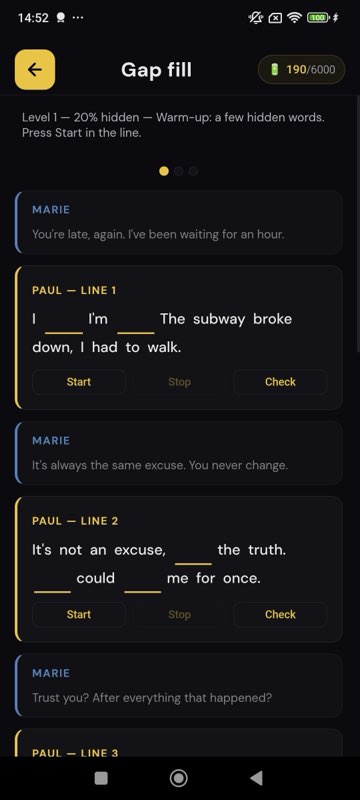
- Choose the character, then work the speech in memorisation mode: 20 % of the words hidden on the free plan, 50 % and 80 % on Pro.
- Hide the text and say it beat by beat. Each beat gets a text accuracy score, 90 % and above green, 70 % and above gold; at the end, the review colours the words you missed or changed.
Set the app language to English (UK or US) so the speech recognition expects English. The full protocol is in our audition monologue guide.
What the app does not do
- It does not contain these texts: no monologue library, no “open in app” button. You paste the speech.
- It does not read your monologue to you, judge your acting or film a self-tape.
- The score measures whether you said the words of the text. Archaic words and names are where speech recognition is least reliable, so read the review with that in mind.
Monologue questions
Are Shakespeare's monologues in the public domain?
Yes. Shakespeare died in 1616, and the words of his plays are free to copy and perform. A particular modern edition's notes, cuts and spellings can still be protected, so copy from a free transcription such as Project Gutenberg.
Can I use any translation of Chekhov, Ibsen or Molière?
No. The play is public domain, but each translation has its own copyright. Use a translation whose translator died more than 70 years ago and which was published before 1929, like those credited on this page.
How long should an audition monologue be?
As long as the audition notice says. Many calls set a time limit; time yourself out loud, at performance pace, and cut the speech to fit rather than speeding up.
Why don't you print the full monologues here?
The full plays are a click away, and the scene around a speech matters: read it before you choose. Each row links to a free full text.
Can I rehearse these monologues in the app for free?
Yes. Paste the speech in NAME: line format, one beat per line. The free plan covers step-by-step rehearsal, scores, the review and the first memorisation level; every speech here fits its 5,000-character limit.
Sources
Texts: Project Gutenberg, Wikisource (Marian Fell's Chekhov, E. P. Coleridge's Euripides) and the Monadnock Valley Press (Brian Hooker's Cyrano), opened on 6 October 2026. Translators' dates: Gutenberg and Wikisource author pages, Wikipedia for Brian Hooker, the Bibliothèque nationale de France authority record for Charles Heron Wall. A broken link or a wrong date? Tell us at contact@masteringtheatre.com.
Import one page. Run one line. See a % score.
Free plan, no card. Android (10 languages) and iOS (5 languages). Pro 2.99 €/month, Premium 4.99 €/month.
Get the app →This page describes the app as it was on 2026-10-07. A score measures text accuracy, not talent. Published 2026-10-06 · updated 2026-10-07.