Last-minute audition: 90 minutes, one monologue, a protocol
The sides arrived at 6 pm. The audition is at 10 tomorrow. You do not need a philosophy of acting tonight; you need the words in your mouth, on a cue, by bedtime, and a clean run in the morning. Here is the plan, minute by minute.
Minutes 0-10 — Get the text in, decide the cut
Paste the text, open the PDF, or photograph the pages (photo import is a Pro feature; the free plan takes up to 5,000 characters per import, which covers most sides). Read it once out loud, both roles, at full volume, without stopping to fix anything. Decide now what you are actually doing tomorrow: the whole side, or the two pages they will most likely ask for. Select that passage and your role. Everything else waits.
Minutes 10-30 — Cues out loud, lines visible
Run the passage with the other roles spoken to you and your lines on screen. Say every line at performance volume. You are not acting yet; you are attaching each line to the sound of its cue. Any line that scores red, repeat immediately, twice, then continue. Do not restart from the top; the top is the part you will know best anyway.
For a monologue, do the same with the text split into beats: each beat is a “line”, the previous beat is its cue.
Minutes 30-50 — Hide, retrieve, count
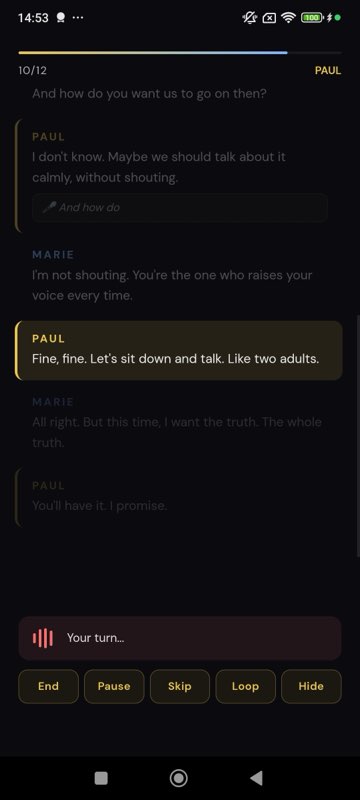
Switch to memorisation: 20 % of your words hidden, then 50 %. Say each line, fill the blanks, check only when you are truly stuck (a check counts, and it should). When the 50 % pass runs without checking, go back to rehearsal with your lines hidden entirely and the cue spoken. Now the score means something: green is off book, gold is nearly, red is tomorrow morning's list.
Minutes 50-70 — One fluid run, then read the review
If you have Pro, run it in fluid mode with a two-second silence, phone at eyeline, no touching. Otherwise step-by-step with a tap after each line is fine. Then read the end-of-session review: every word you missed or changed is highlighted. Write the changed words on paper. There are usually three to six, and they are the same ones each time: a synonym you prefer, a list out of order, two lines that begin the same way.
Minutes 70-85 — Fix the list, not the scene
Take each word on your list, say the author's version five times with exaggerated stress, then run only the line it belongs to, with its cue, three times. Do not run the whole scene again tonight; you will do that in the morning with a rested brain, which is worth more than a tired eighth pass.
Minutes 85-90 — Stop
One last run, lines hidden, no repeats, whatever the scores. Then put it down. Sleep does a real part of the memorising, and a monologue drilled to exhaustion at midnight is the one that comes out flat at ten.
Morning: the 15-minute clean-up
- Cold start: say the first line of every beat, out of order, no cue (2 min).
- Yesterday's list, each word five times (3 min).
- One run with lines hidden and cues spoken; anything red, twice (8 min).
- One run for the acting only, no phone, no score (2 min).
If you have no monologue at all
Some open calls and drama-school rounds ask for “a contemporary monologue of your choice” and you have none ready. The app's Training Audition feature (Pro) generates an original monologue from a few choices (genre, gender, age, length) that you can save and rehearse immediately with the same loop; it costs two energy credits per generation. It will not be Chekhov, and a panel expecting a published text should get one, but for a workshop round or a practice run it beats an empty page at 6 pm.
What the score is, and is not
The percentage is text accuracy, computed on the phone from what speech recognition heard. It is forgiving of homophones and, on the default setting, of near-misses; on Pro you can make it strict. It does not measure whether the line was true. Tomorrow's panel measures that. Tonight's job is to make sure they never see you reach for a word.
Audition-night questions
Can I rehearse a monologue, not just a scene?
Yes. Write it under your character's name with one beat per line: the app waits for each beat, scores it and moves to the next. Generated audition monologues (Pro) are rehearsed the same way.
How do I get a cue if the monologue has no other character?
There is no spoken cue in a monologue; the previous beat is your cue. Hide your lines and use the prompter (Pro) for a nudge on the first words when you dry.
Do I need an account or a payment to start tonight?
No. The free plan installs without a card and includes step-by-step rehearsal, scores, the review and memorisation level 1.
Is anything of my sides stored online?
Recognition and scoring are on the device. Text is sent only for optional AI features and cloud voices. Rehearsing with system voices uses no credits and no server.
What if the sides are in a photo?
Photo import with text recognition (up to six pages) is part of the Pro plan; a PDF with real text is read locally on every plan.
Import one page. Run one line. See a % score.
Free plan, no card. Android (11 languages) and iOS (6 languages). Pro 2.99 €/month, Premium 4.99 €/month.
Get the app →This page is written from the app as it is today (September 2026). A score measures text accuracy, not talent. Published 2026-09-14.