Cue-based memorization: learn the line before your line
Actors who dry on stage usually know their line. What they lost is the trigger: the last words of the other character that should have pulled it out. Cue-based memorisation trains the trigger on purpose, so that the line arrives because the cue arrived, not because you remembered where you were in the scene.
Why cues fail before lines do
When you learn from the page, you see cue and answer together, so your brain never has to retrieve the answer from the cue: the eye does the work. In performance the cue comes in through the ear, in someone else's rhythm, sometimes slightly altered, and the eye has nothing to offer. The line is in there; the road to it was never built.
The method in four moves
- Mark the cue. On your script, underline the last three to five words of every line that precedes yours. Those words are now part of your line.
- Say the cue, then your line. Drill each pair aloud: cue words under your breath, your line at full volume. Ten pairs, twice through. You are welding.
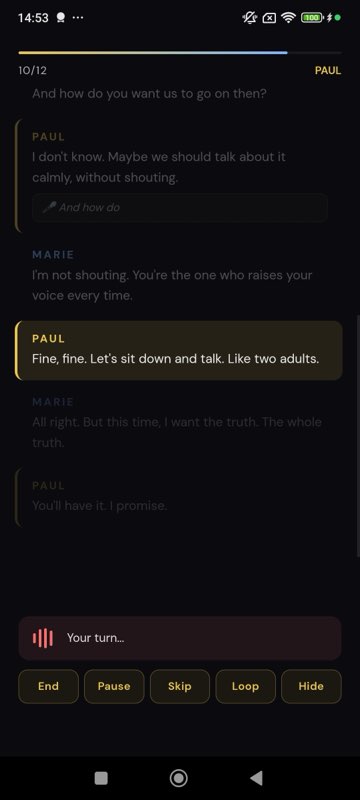
- Hear the cue from outside. Have the other roles spoken to you with your lines hidden. MasteringTheatre does this: it reads every role you do not play (phone voices free, HD voices Pro), waits, and listens to your line with on-device speech recognition.
- Check the count. Each line gets a score, ≥ 90 % green, ≥ 70 % gold, below red, and the end-of-session review highlights the words you missed or changed. A line that scores red on a cue you knew is a broken trigger: drill that pair, not the scene.
Cues that look alike
The classic trap: two lines of your partner that end the same way (“…isn't it?”) and pull two different answers. Cue-based learning exposes this early because the score drops on exactly those lines. Fix it by lengthening the cue you learn (five words instead of three) and by attaching the meaning: the first “isn't it?” is about the money, the second about the letter. Then run both pairs back to back until the answers stop swapping.
Cues that change
Partners paraphrase their cues; directors cut them. Learn the cue as an idea as well as a string of words, and rehearse it at different speeds so you stop depending on one exact rhythm (reading speed 0.8-1.2× on the free plan, 0.5-2× on Pro). If you always play opposite the same actor, a voice pack of their real lines, recorded once, gives you the true rhythm at home (recording is free, using a pack in rehearsal needs Pro).
Combining cues with blanks
Cue drilling handles the trigger; progressive blanks handle the body of the line. Use memorisation mode first, 20 %, then 50 %, then 80 % of your words hidden (level 1 free, levels 2-3 Pro), with the partner's lines visible as context, then move to spoken-cue runs. The two methods fix different failures; most dries are one or the other.
A ten-minute cue drill
- Underline cues on two pages (2 min).
- Pairs aloud, cue then line, twice through (4 min).
- Spoken cues, lines hidden, once; red lines twice (3 min).
- Read the review; note which cues broke (1 min).
What this does not fix
A cue drill fixes triggers. It does not fix a line you never learned, a list you never ordered, or an intention you never chose. The score is text accuracy, not a note on the acting, and the partner in the app never interrupts, never corrects out loud and has no emotion setting. It gives you the cue and the truth about what you said; the rest is rehearsal with people.
Cue questions
How many words of the cue should I learn?
Three to five, more when two cues look alike. Learn the idea of the cue too, so a paraphrased cue still triggers the line.
Do I need the app to do this?
No; a friend reading the other part with your line covered does it. The app replaces the friend at 11 pm and adds the per-line count that a friend rarely gives you.
What if the scene has a long speech with no cues inside it?
Split the speech into beats and treat each beat's last words as the cue for the next. In the app, write it one beat per line under your name so each beat is scored separately.
Does the partner wait if I hesitate?
In step-by-step mode (all plans) it waits until you tap Validate. In fluid mode (Pro) it waits for a silence of the length you set, 0.5 to 10 seconds; the prompter (Pro) can show the first words after 3 to 15 seconds.
Which languages does it recognise?
11 on Android, 6 on iOS, with English UK and English US as separate options.
Import one page. Run one line. See a % score.
Free plan, no card. Android (11 languages) and iOS (6 languages). Pro 2.99 €/month, Premium 4.99 €/month.
Get the app →This page is written from the app as it is today (September 2026). A score measures text accuracy, not talent. Published 2026-09-14.