How to get off book faster
“Off book” does not mean you can recite the scene from the top. It means that when your partner says their line, yours arrives, complete, in the author's words, without a look at the floor. Most actors train the first thing and are surprised when the second fails. Here is how to train the second directly.
Reciting is not off book
You can say your speeches in the shower and still dry in the room, because in the shower you provide your own cue: you know what comes next because you are saying all of it. On stage the cue comes from someone else, in a slightly different rhythm, and your line has to be triggered, not recalled from a list. Getting off book faster means practising the trigger, not the list.
Step 1 — Learn the cue as the first words of your line
For each of your lines, take the last three or four words of the line before it and treat them as the beginning of yours. “…and I said no.” → “Then why are you still here?” becomes one unit: said no / then why are you still here. When you drill, say the cue words under your breath, then your line at full volume. You are welding the two together.
Step 2 — Hide a little, then almost everything
Blank 20 % of the words of your lines and say them filling the gaps; then 50 %; then 80 %. The easy pass gets every line said once with a small effort, the hard passes make retrieval real. In MasteringTheatre the memorisation mode does the masking (meaningful words first, function words last, the same mask each time you rerun a level; level 1 free, levels 2-3 Pro) while the other characters' lines stay visible as context.
Step 3 — Run it against a spoken cue, lines hidden
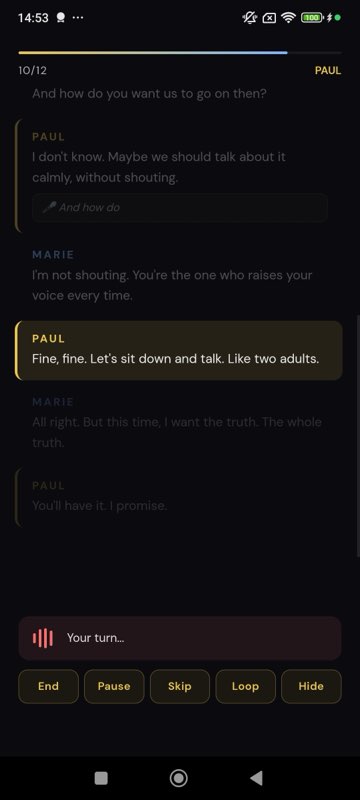
Now the test. The other roles are spoken to you (phone voices free, HD voices Pro), your lines are hidden, and you answer. On-device speech recognition transcribes what you said and scores the line: ≥ 90 % green, ≥ 70 % gold, below red. Red: repeat twice, move on. Do not restart from the top; that is how the first page gets learned five times and the last page never.
Step 4 — Read the review, drill only the list
At the end, the review highlights every word you missed or changed. The list is usually short and always the same: a synonym you prefer, a list whose order is loose, two lines that start alike. Drill those words, in their lines, with their cues, three times each. Not the scene. The list.
Step 5 — Prove it without the page
An off-book run is one clean pass with no page, no prompter and no repeats, whatever the scores. If you have Pro, fluid mode validates each line after a silence you set, so the run flows without touching the phone; the prompter, if you leave it on, shows only the first words of a line after 3 to 15 seconds, which is a fair nudge and an honest signal that you were not quite there.
Where a real voice helps
If the rhythm of the real partner is what trips you, ask them to record their lines once into a voice pack. The app then uses their voice as your cue when they are absent and still scores you (recording is free; rehearsing with a pack needs Pro). Understudies: record the cues, not the performance.
Timing that works
- Two sessions of twenty minutes on different days beat one of sixty. Sleep does part of the work.
- One passage per session. Two pages, not the act.
- Voiced, not whispered. Low is fine; whispering builds a different memory.
- Stop after one clean run. The eighth run flattens lines into sing-song.
What the score is
A percentage of text accuracy, computed on the phone from what recognition heard, forgiving of homophones and, at the default setting, of near-misses (Pro can make it strict). It is not a judgement of the acting. Off book is the floor, not the ceiling; the app's job is to get you to the floor quickly so that rehearsal can start from there.
Off-book questions
How long does it take to get off book on a two-page scene?
With cue-first learning, progressive blanks and spoken runs, usually two evenings: one to get the words in, one to clean the list. Long lists and speeches take a third.
Should I learn my lines before blocking?
Learn the words first with this method, then let blocking attach itself to them; moving while you drill helps, but do not invent business to remember lines.
What if my partner changes their cue in rehearsal?
Learn the cue as meaning, not only as words: the last idea of their line. The spoken-cue runs at a faster or slower speed (0.8-1.2× free, 0.5-2× Pro) help you stop depending on one exact rhythm.
Does the app work for a monologue?
Yes. Write it under your name with one beat per line; each beat is validated and scored separately. There is no spoken cue in a monologue, so the previous beat is your cue.
Is anything of my script sent online?
Recognition and scoring are on the device. Text is sent only for optional AI features and cloud voices; rehearsing with system voices uses no credits and no server.
Import one page. Run one line. See a % score.
Free plan, no card. Android (11 languages) and iOS (6 languages). Pro 2.99 €/month, Premium 4.99 €/month.
Get the app →This page is written from the app as it is today (September 2026). A score measures text accuracy, not talent. Published 2026-09-14.