How to memorize lines fast: the 20/50/80 method
Rereading a page ten times feels like work, but it mostly trains your eyes. Memory is built by retrieval: hiding the words and pulling them back. This method makes retrieval progressive, so it never gets so hard that you give up.
The principle: hide a little, then a lot
If you hide the whole speech on the first try, you fail, peek, fail, peek, and learn mostly frustration. If you hide a fifth of the words, you can already say the line, your brain fills the gaps from context, and each successful gap is a small memory trace. Then you hide half. Then almost everything. Three passes, one evening, one page.
The ratios matter less than the order: easy pass, hard pass, expert pass, each one only starting when the previous one runs clean.
Pass 1 — 20 % hidden: the warm-up
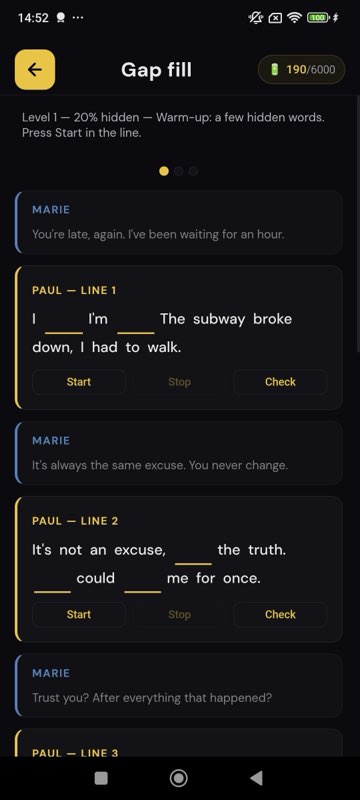
Take your text and blank out roughly one word in five. Blank the words that carry the sentence, not “the” and “of”. Say each line out loud, filling the gaps. Do not look at the original until you have said the whole line. The aim is not accuracy yet: it is to say the shape of every line once with a small effort.
In MasteringTheatre the Memorisation mode does this for you: it masks 20 % of the words of your lines, choosing the meaningful ones first (function words are the last to disappear), while the other characters' lines stay visible as context. The mask is deterministic, so the same words are hidden every time you rerun the level, which is what you want for drilling.
Pass 2 — 50 % hidden: where it gets real
Now every other word is gone. This is the pass where the cue starts doing the work: you say your line because the partner's last words trigger it, not because you can read it. Say the partner's line out loud too, or have it read to you. When you dry, look, say the line twice, move on. Do not restart the scene; restarting is how people spend forty minutes on the first half.
In the app, level 2 masks half the words. A “Check” button reveals the line if you are stuck, but every line you check is counted against you in the session score, which is honest: peeking is a fact, not a sin.
Pass 3 — 80 % hidden: the expert run
Almost nothing is left on the page except the smallest words. If you can run the scene like this, you are off book for practical purposes. Anything you still miss here is a real gap, not a lack of practice: write those words down. They are usually one of three things: a synonym you prefer (“wanted” for “asked”), a list whose order you have not fixed, or a line that starts like another line.
Then say it to someone who listens
Memorising with blanks gets the words into your head. Getting them out of your mouth, in rhythm, on a cue you did not read, is a different skill, and it is the one that fails on stage. So the last step is a run where you cannot see anything and something tells you afterwards what you actually said.
That is the rehearsal mode of the app: the other roles are spoken, you answer, on-device speech recognition scores each line (≥ 90 % green, ≥ 70 % gold, below red) and the review at the end highlights the words you missed or changed. The score is about text accuracy, not talent. But a red line at the end of an evening tells you exactly where tomorrow starts.
Six things that make lines stick faster
- Out loud, always. Silent reading is recognition, not recall.
- Cue first. Learn the last three words of the line before yours as part of your line.
- Move. Walk the blocking, or any blocking, while you drill; the body remembers turns.
- Short sessions, twice. Twenty minutes tonight and twenty tomorrow morning beat an hour tonight. Sleep consolidates.
- Fix the synonyms early. Your brain will keep offering the word you prefer. Say the author's word five times, oddly stressed, so it becomes the strange one you notice.
- Keep a review. A list of the words you changed is worth more than a feeling of “I think I know it”.
What to expect from the app, plainly
Memorisation mode is free at level 1 (20 %); levels 2 and 3 need the Pro plan. It costs no credits at any level because everything happens on the phone. It does not use AI to “teach” you the text; it hides words and counts your checks. The AI parts of the app (per-line direction, coaching across sessions, generated audition monologues) are separate features.
Questions about memorising lines
How long does it take to memorise a page?
With three progressive passes and cues out loud, most actors get a two-page scene to an 80 % masked run in one evening and clean it the next morning. Long lists and near-identical lines take longer.
Should I learn the other characters' lines too?
Learn their last few words, the cue. You do not need the rest, but you need to hear it, which is why the app keeps their lines visible and speaks them in rehearsal.
Does the app choose random words to hide?
No. The choice is deterministic and prefers meaningful words; function words are hidden last. Rerunning a level hides the same words, which is what makes drilling work.
What if I keep saying a synonym?
The review highlights changed words. Drill the author's word out loud with exaggerated stress a few times; a strict scoring setting (Pro) will also stop accepting near-misses.
Is memorisation free?
Level 1 is free and costs no credits. Levels 2 and 3 are part of the Pro plan (2.99 €/month).
Import one page. Run one line. See a % score.
Free plan, no card. Android (11 languages) and iOS (6 languages). Pro 2.99 €/month, Premium 4.99 €/month.
Get the app →This page is written from the app as it is today (September 2026). A score measures text accuracy, not talent. Published 2026-09-14.