Drama school line learning: the homework scene, done in the dorm
Scene study gives you a partner for two hours a week and a scene that needs twenty. The rest happens in a dorm room, a kitchen, a corridor, with the other person somewhere else. This is a routine for that time, built so that class time goes into acting instead of “sorry, line?”.
What class time is for, and what it is not for
Teachers say it in every first week: come off book, so we can work. Yet half of scene-study time still goes into dropped cues and paraphrases. The reason is not laziness. It is that learning lines alone, from the page, produces recognition, not recall. You know the line when you see it; you do not have it when your partner's cue arrives from outside, out loud. The homework has to reproduce that cue.
The dorm routine (25 minutes, most nights)
- Import the scene once. Paste the text or open the PDF from the class folder; photograph the printed pages if that is all you have (photo import is a Pro feature; a free import takes up to 5,000 characters). Choose your role. The passage you are working this week is two taps.
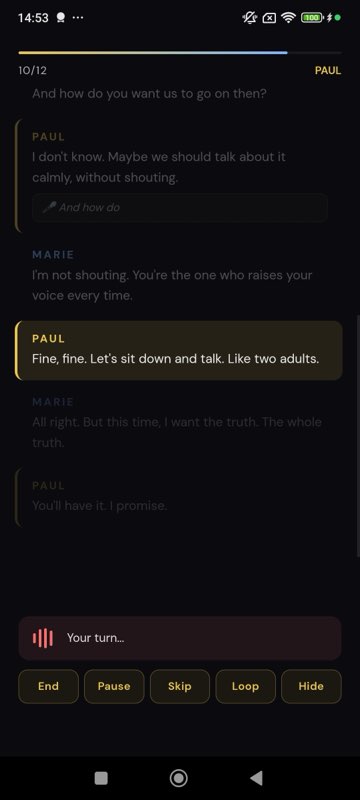
- Cues in one ear. The other roles are spoken to you: phone voices on the free plan, HD voices on Pro. Earphones keep the room quiet. Say your lines at a voiced level, not a whisper; whispering does not build the same memory.
- Lines visible, once. Rhythm only. Then hide your lines and run it again.
- Score, repeat, move on. Each line gets a percentage: ≥ 90 % green, ≥ 70 % gold, below red. Red: say it twice, then next. Never restart from the top.
- Read the review. The words you missed or changed are highlighted at the end. The three or four words you keep changing go on a sticky note for tomorrow.
Your scene partner's real voice, recorded once
A synthetic cue works. Your partner's actual voice, with their rhythm and their odd pause before the word you always miss, works better. In the app, a partner records their lines once, line by line, into a voice pack that stays on your phone and can be sent to you as a file. From then on you rehearse against their real voice when they are not there, and the app still listens to you and scores you. Recording is free on every plan; rehearsing with a voice pack needs Pro. Record each other's parts in the ten minutes after class, while the phone is out anyway.
Paraphrase: the drama-school disease
Students paraphrase because they understood the line, which is good, and then say their own version, which is not. The review catches it: “I never wanted this” for “I never asked for this” is a highlighted word, not a feeling. On Pro you can set the scoring to strict, which stops close-sounding substitutions from passing. Drill the author's word out loud with exaggerated stress until it becomes the one you notice.
Memorisation with blanks, for the long speeches
For the monologue in act two, use memorisation mode before rehearsal mode: 20 % of the words hidden, then 50 %, then 80 %. The mask prefers meaningful words and is the same every time you rerun a level, so you drill the same gaps. Level 1 is free; levels 2 and 3 are Pro. It costs no credits because everything happens on the phone.
Notes you can argue with
When the text is in and you want a starting point for the acting, the AI direction feature (Pro) writes a note per line: intention, subtext, tone, one to three words to stress, a physical or rhythm suggestion. Treat these as a classmate's opinion, not your teacher's. They disappear when the session ends, which is appropriate. The coaching feature, across sessions, points out milestones: first 90 %, a weak line finally conquered.
Audition season
For school rounds and open calls, the same loop works on a monologue written under your name with one beat per line. If you need a practice monologue and have none, Training Audition (Pro) generates an original one from a few choices (genre, gender, age, length) for two energy credits. Panels expecting published texts should get published texts; for a workshop round it is better than an empty page.
Honest limits
The app does not film, does not interrupt, has no emotion setting for the partner, and does not correct you mid-line. A score is text accuracy, not talent. What it gives back to you is the two hours a week with a real partner and a real teacher, spent on the acting.
Student questions
Is there a student price?
No separate student plan. The free plan covers step-by-step rehearsal, scores, the review and memorisation level 1; Pro is 2.99 €/month, Premium 4.99 €/month, cancellable any time.
Can the whole class use the same scene?
Each student imports the scene on their own phone and picks their role. Voice packs can be shared as files so a cast can exchange real cues.
Which languages, for international students?
11 languages on Android (French, English UK, English US, Spanish, German, Portuguese, Italian, Dutch, Polish, Russian, Turkish) and 6 on iOS (French, English UK, English US, Spanish, German, Russian).
Does it work in a shared room at night?
Yes with earphones for the cues; your own lines need to be voiced, but low is fine. Rehearsing with system voices is unlimited and uses no credits.
Can my teacher see my scores?
No. Sessions and history stay on your phone; there is no teacher dashboard. Show the review on your screen if you want to discuss it.
Import one page. Run one line. See a % score.
Free plan, no card. Android (11 languages) and iOS (6 languages). Pro 2.99 €/month, Premium 4.99 €/month.
Get the app →This page is written from the app as it is today (September 2026). A score measures text accuracy, not talent. Published 2026-09-14.