For acting teachers: a homework tool, not a replacement
You did not become a drama teacher to spend the first twenty minutes of every scene-study class on dropped lines. This page describes, without marketing, what MasteringTheatre does for line homework and for generating class material, and what it leaves entirely to you.
The problem it addresses
Students learn lines from the page, silently, and arrive with recognition instead of recall: they know the line when they see it, and lose it when the partner's cue comes from outside. Rehearsal time then goes into text instead of acting. The app gives each student a spoken cue at home, listens to the line, and counts what was actually said. That is its job. It has no opinion about the acting unless asked, and even then only a written suggestion per line.
What a student does with it, in five lines
- Imports the scene (pasted text, PDF, or a photo of the pages on the Pro plan; the free plan takes up to 5,000 characters per import), picks a passage and a role.
- Hears the other roles spoken (phone voices free, HD voices on Pro) and answers out loud; on-device speech recognition transcribes the line.
- Gets a score per line, ≥ 90 % green, ≥ 70 % gold, below red, and repeats or moves on.
- Reads a review at the end with missed and changed words highlighted; the history keeps past sessions.
- Optionally drills long speeches with memorisation mode: 20 %, 50 % then 80 % of the words masked (level 1 free, levels 2-3 Pro).
The partner never interrupts and never corrects out loud; feedback comes after the line and after the scene. The free plan is enough for the homework loop: step-by-step rehearsal with a tap to validate each line, scores, review, memorisation level 1.
Cues in the students' real voices
Ask a cast to record each other's lines once, line by line, in the ten minutes after class. Each recording becomes a voice pack, a file that stays on the phone and can be sent to a scene partner. At home, the student then rehearses against a classmate's real voice and rhythm, not a synthetic one, and the app still scores them. Recording is free; rehearsing with a pack requires Pro.
Original scenes for a group, with a PDF per role
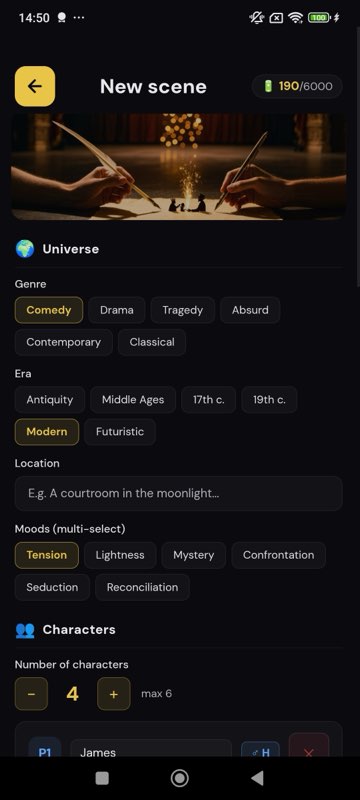
When you need a short scene for three students in a specific register and no published text fits, the “Create your scene” feature writes one: genre, place, mood, characters with a name, gender and a trait, duration, language level. The result can be rehearsed immediately in the app, saved to a library, and exported as a PDF per role with that role's lines highlighted, ready to print.
| Pro (2.99 €/month) | Premium (4.99 €/month) | |
|---|---|---|
| Characters | 2 to 3 | 2 to 6 |
| Duration | 5 to 10 minutes | 5 to 45 minutes |
| Performer age | 15-18, adults | also 5-7, 8-10, 11-14 |
| Stage directions, emotional arc | — | yes |
| Pedagogical tools | — | objectives (listening, emotion, body, rhythm, memorisation, improvisation) and one dramatic constraint: secret, obstacle, time, space or silence |
| Full show for a class | — | yes, 10 to 45 minutes, fixed cost |
Generation is paid in energy credits (a daily allowance included in the plan); a scene costs a few credits, a full show a fixed amount. The text is generated by a language model, so read it before handing it out, as you would any new material. It is a starting point for an exercise, not literature.
What it does not do, so you are not surprised
- No teacher dashboard. Scores and history stay on the student's phone. If you want to see a review, they show you their screen.
- No classroom licence. Each student installs the app individually; there is no bulk plan today.
- No filming. It is a rehearsal partner, not a self-tape recorder.
- No judgement of acting. The score measures text accuracy. The optional AI direction (Pro) gives per-line suggestions on intention and stress that a student should argue with.
- No emotion setting for the partner. It reads; the student acts.
How teachers actually use it
- Off-book deadline with proof: “Bring a review with no red lines by Thursday.”
- Absent partner protocol: voice packs recorded in week one, so illness does not stop the scene work.
- Warm-up material: a generated two-hander in a chosen register for a cold-reading exercise, printed per role.
- Audition prep: monologues written one beat per line; Training Audition (Pro) can generate a practice monologue when a student has none.
Languages and platforms
Android: 11 languages (French, English UK, English US, Spanish, German, Portuguese, Italian, Dutch, Polish, Russian, Turkish). iOS: 6 (French, English UK, English US, Spanish, German, Russian). Speech recognition runs on the device; text is sent to a server only for AI features and cloud voices. No ads, no advertising identifiers. Questions from a school: contact@masteringtheatre.com.
Teacher questions
Is it suitable for under-13s?
The rehearsal loop is text and voice only, with no social features and no ads. Generated scenes for performer ages 5-7, 8-10 and 11-14 are a Premium option with stricter generation rules. Installation and accounts follow each store's age policies.
Can students import a whole play?
On the free plan an import is limited to 5,000 characters, so students import the scene they are working on. Pro and Premium accept longer texts and photographed pages (up to six per import).
Does it replace scene partners?
No. It replaces the empty room at 11 pm. The point is that class time with real partners goes into acting.
Can I get a bulk or school licence?
Not today. Each student subscribes individually if they need Pro features; the free plan covers the line-homework loop.
Is there anything for job-interview or public-speaking classes?
A job-interview simulation exists on Premium (an AI recruiter asks questions out loud, adds stress events, writes a review). There is no public-speaking module.
Import one page. Run one line. See a % score.
Free plan, no card. Android (11 languages) and iOS (6 languages). Pro 2.99 €/month, Premium 4.99 €/month.
Get the app →This page is written from the app as it is today (September 2026). A score measures text accuracy, not talent. Published 2026-09-14.