Running lines at 11 pm, when nobody can read with you
The best time to run lines is often the worst time to ask anyone to help: after the shift, after the kids, after the two-hour rehearsal where you spent your energy on someone else's scene. This is a page about that hour: how to use it without waking the flat and without fooling yourself.
Three problems with late-night line runs
- No reader. The person who usually gives you the cue is asleep, or is in the cast and has their own lines to learn.
- No volume. You cannot do the scene at performance level in a shared flat at 11 pm, so you whisper, and whispered lines do not stick the same way.
- No honesty. Tired, alone, you finish the page and feel like you know it. Nobody counted the words you replaced.
Solve the reader problem first
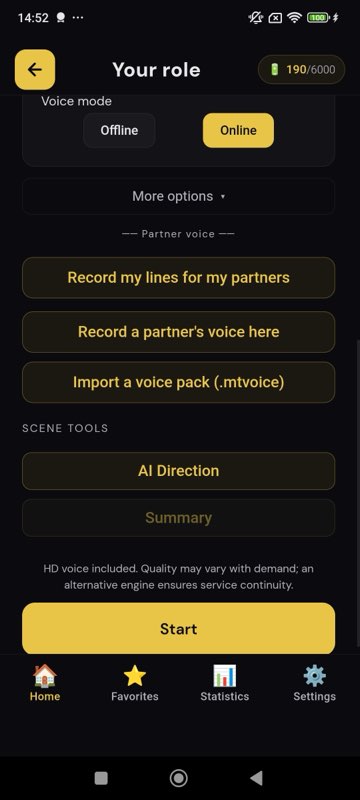
A reader's job is to say the other lines and stop. That job can be done by a phone. In MasteringTheatre you import the scene (paste, PDF, or photo on Pro), pick your role, and the other roles are spoken to you, with a voice per character. Then it listens to your line with on-device speech recognition and gives it a score. On the free plan you tap Validate after each line; on Pro, a silence of your choice validates it, so the scene runs on its own and you keep your hands free.
If you always work with the same partner, there is a better reader still: their own voice. A partner can record their lines once into a voice pack; from then on, at 11 pm, the app plays their voice as your cue and still scores you (using a pack in rehearsal needs Pro). Understudies: ask the actor you cover to record the other parts, not theirs. You need their cues, not their performance.
Solve the volume problem with earphones and a threshold
Put the partner in one earphone so the flat hears nothing of the cues. For your own lines, speak at a low but voiced level, not a whisper: recognition needs pitch, and so does your memory. If a neighbour is the issue, do the late run at half volume for the words and do one full-volume run in the morning in the car or the stairwell. Late night is for text; morning is for breath.
Adjust the reading speed too. At 0.8× the cue is slower and easier to catch when you are tired; at 1.2× (up to 2× on Pro) you can test whether the lines survive a partner who rushes.
Solve the honesty problem with a count
Every line gets a percentage: ≥ 90 % green, ≥ 70 % gold, below red. At the end, the review highlights the words you dropped or changed. Tired brains substitute synonyms without noticing; the review notices. That list, three to six words most nights, is what you look at the next morning, instead of running the whole scene again.
The score is text accuracy, not a verdict on your acting. Late at night that is exactly what you want: a machine that tells you what you said and nothing else.
A 25-minute late-night run
- Choose one passage, not the whole act. Two pages (2 min).
- Cues in one ear, lines visible, low voice, once through (5 min).
- Lines hidden, prompter set to 8 seconds so it nudges you only when you really dry (Pro), once through, red lines twice (10 min).
- Read the review, write the changed words on tomorrow's note (3 min).
- One last run, no repeats, then stop. Sleep is part of the method (5 min).
What not to do at 11 pm
Do not learn a new scene from scratch; learn the scene you half know. Do not push past one clean run; the eighth run is where lines get flattened into sing-song. And do not judge the acting on the late run; you are tired and the voice in your ear is a phone. Judge the words. The rest is for the room, in daylight, with people.
Late-night questions
Will the app wake anyone up?
Not if the partner's voice is in earphones. Your own line has to be voiced, but low is fine; whispering is what to avoid.
Does it need the internet at night?
Speech recognition runs on the phone and system voices are local. Only HD or generative voices and AI features use the network.
Can I rehearse just one page of a long play?
Yes. You select the passage in two taps; the rest of the script stays imported for another night.
What is the prompter?
A Pro option in step-by-step mode: if you stay silent for a delay you set (3 to 15 seconds), the first words of your line appear, so you get a nudge instead of the whole answer.
Is there a limit on late-night use?
Rehearsing with system voices is unlimited on every plan and uses no credits. Only AI features and cloud voices draw on the daily energy.
Import one page. Run one line. See a % score.
Free plan, no card. Android (11 languages) and iOS (6 languages). Pro 2.99 €/month, Premium 4.99 €/month.
Get the app →This page is written from the app as it is today (September 2026). A score measures text accuracy, not talent. Published 2026-09-14.