Learn lines overnight: one page, one role, call time at 7
The new sides came through at 9 pm and the scene shoots in the morning. You will not learn them by reading them twelve times in bed. You will learn them with two short sessions, a spoken cue, and a night's sleep in between. Here is the split.
The mistake: one long session at midnight
Cramming feels productive because the page becomes familiar. But familiarity is recognition: you know the line when you see it. On set, nobody shows it to you; someone says a cue and waits. What you need is recall on a cue, and recall is built by retrieval attempts spaced out, with sleep in the middle. Two sessions of twenty minutes, tonight and at 6 am, beat ninety minutes tonight, every time.
Tonight, session 1 (20 minutes): get it in, on a cue
- Import the page. Paste the sides, open the PDF, or photograph the pages (photo import is a Pro feature; the free plan takes up to 5,000 characters per import, roughly two pages). Pick your role. Two taps select the passage.
- Run it with cues spoken and your lines visible (5 min). The other roles are read to you; you answer at speaking volume. You are pairing each line with the sound that comes before it.
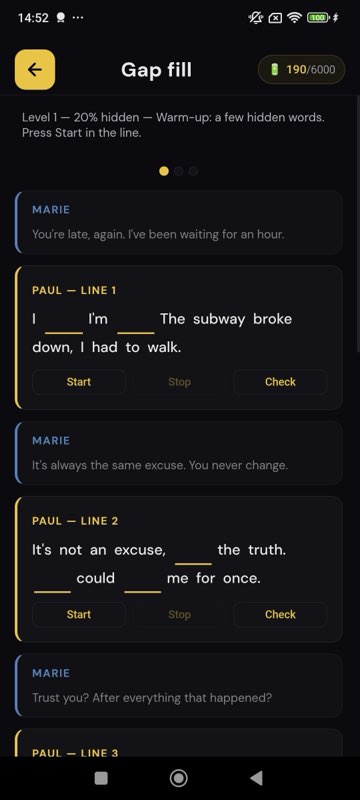
- Hide 20 % of your words, then 50 % (memorisation mode; level 1 is free, levels 2 and 3 are Pro). Say each line filling the gaps. Check only when stuck; a check is counted, which is the point (8 min).
- Run it with lines fully hidden, cue spoken, and read the scores: ≥ 90 % green, ≥ 70 % gold, below red. Red lines: say twice, move on (5 min).
- Read the review: the words you missed or changed are highlighted. Write them on a note for the morning. Then stop (2 min).
Then sleep. Really.
Sleep consolidates what you retrieved, not what you reread. A line you pulled out three times with effort tonight is far more likely to be there at 6 am than a line you stared at for ten minutes. If you wake up at 3 am reciting, that is normal; do not get up and “fix” it.
Morning, session 2 (15 minutes): clean it, then leave it
- Cold start, no cue, no phone: say the first words of every line in the scene, in order (2 min).
- Last night's list: each changed word five times, with the author's stress, in its line with its cue (3 min).
- One run, lines hidden, cue spoken, in the car or the stairwell at real volume. Anything red, twice (7 min).
- One run for the scene, no score, no repeats. Then put the phone away until the set (3 min).
Three things that make overnight learning stick
- Learn the cue as part of your line. The last three words of the previous line are yours too. Say them under your breath before you answer.
- Fix synonyms tonight, not tomorrow. Your brain will keep offering “wanted” for “asked”. The review shows you exactly which words you changed; drill only those.
- Do not add blocking or business tonight. Text tonight, breath and body in the morning, acting on set.
Rewrites at 6 am
Sides change. Paste the new page, select the changed passage only, and run it hidden once. The review will show you the old words fighting the new ones; those are the lines to say three times in the car. Do not relearn the whole scene for two changed lines.
What the app does and does not do here
MasteringTheatre speaks the other roles (phone voices free, HD voices Pro), listens to your line with on-device speech recognition, scores each line and highlights your mistakes afterwards. It does not film you, it does not interrupt, and it never corrects you mid-line. The score is text accuracy, not a note on your acting. Rehearsing with system voices is unlimited and uses no credits, which matters at midnight.
Overnight questions
How much can I realistically learn in one night?
One to two pages of dialogue with this two-session method. A long monologue or a page of technical jargon usually needs a second night; if you have both, learn the exchanges tonight and the long speech tomorrow.
Do I need the internet at 6 am?
No. Speech recognition runs on the phone and system voices are local. Only HD voices and AI features use the network.
Can I skip the memorisation passes and just run it hidden?
You can, but the 20 % and 50 % passes are what keep the first hidden run from being a wall of red. They take eight minutes and save twenty.
What if the scene has four other characters?
Every role you do not play is voiced, with a female or male voice per character. You hear all of them in order; you answer only your lines.
Does it cost anything to use tonight?
The free plan installs without a card and includes step-by-step rehearsal, scores, the review and memorisation level 1. Photo import, fluid mode and the prompter are on Pro (2.99 €/month).
Import one page. Run one line. See a % score.
Free plan, no card. Android (11 languages) and iOS (6 languages). Pro 2.99 €/month, Premium 4.99 €/month.
Get the app →This page is written from the app as it is today (September 2026). A score measures text accuracy, not talent. Published 2026-09-14.