Tongue twisters for actors, sorted by sound
A tongue twister is only useful if you know which sound it is working. Here are twenty-four classics grouped by consonant family, with the protocol that turns them from a party trick into a diction drill: slow and exact first, then rhythm, then speed, and only then the full line at performance volume.
The protocol before the list
- Slow and exact. Half speed, every consonant landed, no rhythm yet. Three times.
- Rhythm. Normal speed, tapping a steady beat. Three times. If a consonant smears, go back to step 1 for that word only.
- Speed. As fast as you can stay exact. Twice. Speed with smearing is worse than no speed.
- Performance volume. Once, as if to the back row. This is the only step that counts.
Two minutes per family, four families a day, rotating. Diction improves through precise repetition of the sound you actually struggle with, not through the whole list at speed.
Sibilants: s, z, sh
- She sells seashells by the seashore.
- Six slippery snails slid slowly seaward.
- The sixth sick sheikh's sixth sheep's sick.
- Susie sits shining silver shoes.
Lip plosives: p, b
- Peter Piper picked a peck of pickled peppers.
- A big black bug bit a big black bear.
- Betty bought a bit of butter, but the butter was bitter.
- Rubber baby buggy bumpers.
Tongue-tip plosives: t, d
- Two tiny tigers take two taxis to town.
- Double bubble gum bubbles double.
- Twelve twins twirled twelve twigs.
- Denise sees the fleece, Denise sees the fleas.
Back plosives: k, g
- How can a clam cram in a clean cream can?
- Good blood, bad blood.
- Crisp crusts crackle and crunch.
- The great Greek grape growers grow great Greek grapes.
Fricatives: f, v, th
- Fred fed Ted bread and Ted fed Fred bread.
- Five fine fresh fish for you.
- Thirty-three thirsty, thundering thoroughbreds thumped Mr. Thurber on Thursday.
- Vincent vowed vengeance very vehemently.
Liquids and nasals: l, r, m, n
- Red lorry, yellow lorry.
- Really leery, rarely Larry.
- Many an anemone sees an enemy anemone.
- Lesser leather never weathered wetter weather better.
Which family is yours?
Most actors have one or two families that smear under pressure: sibilants that whistle, final t and d that vanish, r and l that swap under speed. Record yourself on the list once, at performance volume, and listen for the family that goes first. That is the one to drill daily; the others are maintenance.
Getting scored on them
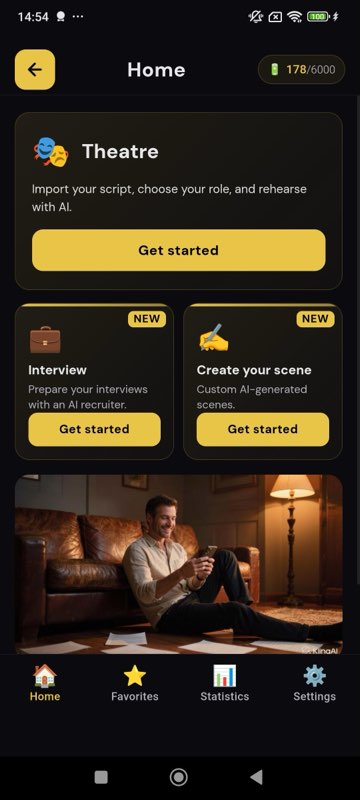
MasteringTheatre has a diction exercise (Pro) that works the same way: you choose a sound family (ten categories: sibilants, lip plosives, tongue plosives, back plosives, fricatives, liquids, nasals, glides, consonant clusters, or a mix), the number of words (12 to 30), an optional timer and a strictness level; the app generates fresh tongue-twister sentences in your language, you say them, and on-device speech recognition scores each one, with a strict setting that refuses smeared or swapped words. Each generation costs two energy credits and nothing is stored, so it is a warm-up, not a course. It is generic by sound family: it does not know which words you personally missed in a scene; that is what the rehearsal review is for.
Before a rehearsal, in six minutes
- Lips and jaw loose: two minutes of hums and lip trills.
- Two families from the list, slow to rhythm (3 min).
- The first line of your scene, at volume, three times, consonants landed (1 min).
Then open the scene. The point of diction work is that nobody in the audience thinks about your diction.
Tongue-twister questions
How often should actors do tongue twisters?
Daily, two minutes per family, rotating, and always before a rehearsal or a performance. Precision matters more than quantity; ten exact repetitions beat fifty fast ones.
Do tongue twisters help with accents?
They help with the consonants of an accent, not with its vowels or music. Use them as one part of accent work, alongside listening and vowel drills.
Can the app generate tongue twisters in other languages?
Yes, in the app's language: 11 languages on Android, 6 on iOS, with English UK and US as separate options. The sentences are generated for the chosen sound family.
Is the diction exercise free?
No, it is part of the Pro plan (2.99 €/month) and each generation costs two energy credits. Rehearsing scenes with system voices, by contrast, is free and unlimited.
Does the score judge my voice quality?
No. It scores whether the words were recognised as said, with a strictness you choose. Resonance, breath and projection are for a voice teacher.
Import one page. Run one line. See a % score.
Free plan, no card. Android (11 languages) and iOS (6 languages). Pro 2.99 €/month, Premium 4.99 €/month.
Get the app →This page is written from the app as it is today (September 2026). A score measures text accuracy, not talent. Published 2026-09-14.