A six-minute voice warm-up before you run lines
Cold lines score worse. Not because you know them less at 7 pm than at 7.10, but because a cold voice drops final consonants, rushes, and mumbles the words you are least sure of. Six minutes fix that, and they are the same six minutes whether you are about to rehearse with people or with a phone.
Why warm up before a line run at all
If you run lines cold, the transcription that scores you hears “I never ask’ for this” with the t gone and gives you gold where you deserved green; more importantly, you rehearse a mumbled version of the line and that is the one that sticks. A warm voice lands consonants, which is what speech recognition and audiences both need. So the warm-up is not a ritual; it is how you make the run count.
The six minutes
- Breath (1 min). Stand, feet under hips. In through the nose for four counts, out on a long “ssss” for as long as it lasts. Four times. The last one, out on “ffff”.
- Hum (1 min). A comfortable middle note, lips closed, teeth apart, until the lips buzz. Slide the hum up a fifth and down again, twice. Then hum a sentence of your scene, no words.
- Lips and tongue (1 min). Lip trills on a slide up and down, four times. Tongue trills, four times. Big chewing with sound, ten seconds. Blow out the cheeks and release.
- Two tongue-twister families (2 min). Pick the two consonant families you smear under pressure and drill them slow then rhythmic, from the sorted list. Not fast. Exact.
- The first line at volume (1 min). Say the first line of the passage you are about to run, to the back wall, three times, consonants landed. Then start the run.
What changes in the run after that
Your scores go up on the lines you actually know, and the review stops showing “missed” final words that you did say but did not land. What is left in red is a real gap, not a cold mouth. That distinction saves the twenty minutes people spend re-drilling lines they knew all along.
Warm-up for a late-night run
At 11 pm in a shared flat you cannot do steps 2 to 5 at volume. Do them at a low, voiced level (not a whisper), with the partner's cues in one earphone during the run. Keep the breath step at full size; it is silent. The full-volume version of the first line goes to the morning, in the car or the stairwell.
What the app does and does not do here
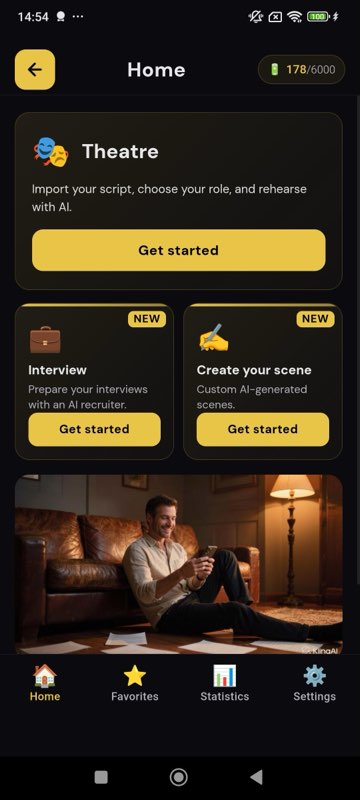
MasteringTheatre has no warm-up module: nothing in the app leads you through breath or lip trills, and this page does not pretend otherwise. What the app does have is next to the warm-up: the diction exercise (Pro) generates tongue-twister sentences for a sound family you choose (ten categories, 12 to 30 words, optional timer, strictness setting) and scores you on them with on-device speech recognition for two energy credits a generation; then the rehearsal itself, where the other roles are spoken to you, you answer, each line is scored and the review shows what you changed. Do the six minutes, then open the scene.
Signs you skipped it
- Gold scores on lines you know cold, with final t, d or s in the review.
- The first three lines of every run score worse than the rest.
- A tight jaw twenty minutes in.
Any of these, stop the run, do the six minutes, start again. It is faster than fighting the scores.
Warm-up questions
Do I need a warm-up before a memorisation session?
Less than before a run: memorisation with blanks is quieter work. Do the breath and hum steps anyway; the lines you drill mumbled are the lines you will say mumbled.
Does the app score my diction during a scene?
No. During a scene it scores whether the words matched the text. The diction exercise (Pro) is a separate, generic drill by sound family; it does not analyse the words you missed in a scene.
Is there a warm-up feature planned?
Nothing to announce. Today the app rehearses, memorises, scores and reviews; the warm-up is yours.
Can I do the six minutes on a train?
Breath and hum, yes. Lip trills and the first line at volume, no. Do those two before you leave and the run on the train with earphones and a low, voiced level.
Which languages does the diction exercise support?
The app's languages: 11 on Android, 6 on iOS, with English UK and English US separately.
Import one page. Run one line. See a % score.
Free plan, no card. Android (11 languages) and iOS (6 languages). Pro 2.99 €/month, Premium 4.99 €/month.
Get the app →This page is written from the app as it is today (September 2026). A score measures text accuracy, not talent. Published 2026-09-14.