Callback prep alone: same sides, new reader
The callback is good news with a trap in it. You know the sides, which is exactly why you will stop working them, and then the reader in the room is faster than the one you imagined, the director redirects you, and the words you knew on Tuesday go. Callback prep is not about learning; it is about making the text survive change.
What changes at a callback
- The reader. Different voice, different pace, often flatter, sometimes another actor with their own ideas.
- The direction. “Try it lighter.” “Faster, you are late for something.” The adjustment is the point of the callback, and it costs text if the text is fragile.
- The pages. Sometimes a new scene the night before. Sometimes the same sides, with a cut.
- You. More at stake, more speed, less breath.
Step 1 — Make the cue variable on purpose
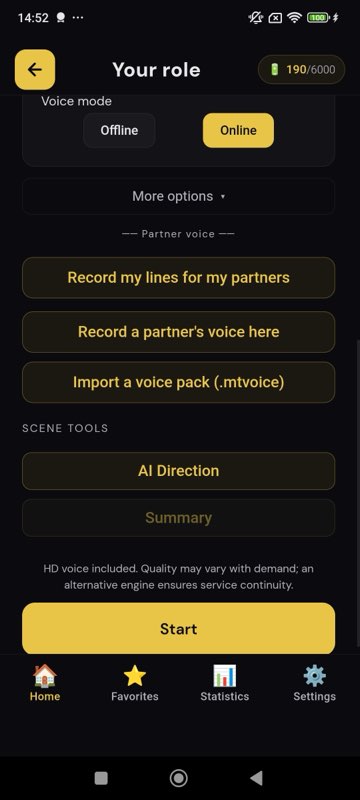
Run the sides with the other roles spoken to you and your lines hidden, three times at three speeds: slow (0.8×), normal, fast (1.2× on the free plan, up to 2× on Pro). If a line only arrives at one speed, it is attached to a rhythm, not to the cue. Drill that pair, cue words then line, until it arrives at all three. In MasteringTheatre the speed is set on the role screen before the run; each line is scored (≥ 90 % green, ≥ 70 % gold, below red) and the review at the end highlights what you changed.
Step 2 — Rehearse the redirect
You cannot predict the note, but you can rehearse taking one. Do the scene with a self-imposed adjustment that changes the rhythm: as if you were late; as if you did not want them to hear; as if it were funny. Keep the lines hidden and keep the score on. The text should not move when the intention does. If it does, the review shows you exactly which words went, and those are the ones to weld to their cues again.
Step 3 — Strict scoring, once
On Pro, set the scoring to strict for one run. The default lenient setting lets close-sounding words pass, which is right for learning and wrong for a callback where the writer may be in the room. Strict refuses the substitutions, and the review after that run is your real list.
Step 4 — New pages, if they came
Paste only the new scene, select it, and use the two-session split: twenty minutes tonight (cues spoken, lines visible once, then blanks 20 % and 50 %, then hidden run), fifteen minutes in the morning (cold start, list, one clean run). The detail is on the overnight page. Do not rework the old sides tonight beyond one run; they are the safe part.
Step 5 — A chemistry read without the other actor
A chemistry read is about listening, and listening is hard when the text is fragile. If you know who you will read with and they are willing, ten minutes on the phone is enough for them to record their lines into a voice pack; you then rehearse at home against their actual voice and rhythm and the app still scores you (recording is free; using a pack needs Pro). If you do not know, the variable-speed runs are the next best thing: they train you to take a cue from anyone.
The night before, in 25 minutes
- Three runs, three speeds, lines hidden; red lines twice (12 min).
- One run with a self-imposed redirect (4 min).
- One strict run (Pro) and its review; drill the list in its lines (6 min).
- One clean run at the pace you intend, no score. Stop (3 min).
What not to do
Do not lock a reading. The callback wants to see you move, and a locked reading breaks in two when it is asked to move. Do not learn the other role's lines beyond their cues. Do not run the sides twenty times; after one clean run at each speed, the extra runs make it sing-song. And remember what the score is: text accuracy, computed on the phone, not a verdict on whether you got the part.
Callback questions
The reader in the first round was very flat. Should I rehearse with a flat cue?
Rehearse with several: the speed setting changes the pace, and system voices are neutral by nature. The aim is a line that arrives from any cue, not a line tuned to one reader.
Can I rehearse the redirect with the app's AI direction?
AI direction (Pro) writes a note per line (intention, subtext, tone, words to stress) that you can use as an imposed adjustment. Treat it as one possible note, not the director's.
They sent a new scene at 10 pm. How much can I do?
Two short sessions with sleep between: get it in tonight with spoken cues and blanks, clean it in the morning. One to two pages is realistic.
Does the app film a mock callback?
No. It is a rehearsal partner, not a self-tape recorder. Film with your camera app if you want to watch yourself take a note.
Does it need the internet the morning of?
No. Recognition, scoring and system voices work on the phone. Only HD voices and AI features use the network.
Import one page. Run one line. See a % score.
Free plan, no card. Android (11 languages) and iOS (6 languages). Pro 2.99 €/month, Premium 4.99 €/month.
Get the app →This page is written from the app as it is today (September 2026). A score measures text accuracy, not talent. Published 2026-09-14.