Public domain scenes for three actors, by casting
Twenty scenes in which exactly three characters speak (a few have a silent or one-line fourth part, noted in the entry), all free to copy, rehearse and perform: twelve by Shakespeare, eight by Wilde, Goldsmith, Sheridan, Jonson, Shaw, Lady Gregory and Strindberg in a public domain translation. Each entry gives the act and scene, the three characters, indicative ages, an estimated length, the opening words and a free full text. We do not reprint the scenes; the links do.
Short answer
A scene is safe to use freely when the author, and the translator for a translated play, died more than 70 years ago and the text was published before 1929. All 20 below pass both tests. Shortest: Lady Macbeth's sleepwalking scene, about four minutes. Most run between six and twelve minutes, and the longest is a whole one-act play.
How we checked “public domain”
The same two tests as our public domain duologues. The author died before 1956, more than 70 years ago, the term used in the UK and the EU. The text was first published before 1929, which places it in the public domain in the United States too. The most recent authors here are Bernard Shaw (died 1950; Candida was published in 1898) and Lady Gregory (died 1932; The Workhouse Ward was first produced in 1908 and published in 1909). For the one translated play, Strindberg's Miss Julia, the test applies to the translator too: Edwin Björkman died in 1951 and his translation was published in 1913.
The words of the play are free; a modern edition's notes, cuts and layout may not be. Every link goes to a free transcription on Project Gutenberg. Rules differ by country, and this page is not legal advice; for a public performance, check with the venue or the festival.
Why rehearse a scene for three
A three-hander changes the job. In a duologue you always answer the one person who just spoke; with three, a cue can come from either side, one character often listens while the other two fight, and alliances shift inside the scene. Three-person scenes are also what acting classes and amateur companies ask for when the group does not divide by two. Choose a scene in which all three parts have something to play, read the whole play first, and agree with your partners on where the scene starts and stops.
- Balance. Some scenes below give one character most of the words (Iago, Falstaff, Lear, Candida). The row says so; swap parts between runs so the work is shared.
- Silent presences. Where a fourth character is on stage without a line, or a servant announces someone in a single line, the row says so. A single line can be cut or given to one of the three.
- Edition. Act and scene numbers are those of the linked text.
How to read the lengths
We counted the speeches and the spoken words of each scene in the linked text, leaving out stage directions, and divided the words by 140 a minute, an unhurried speaking pace. Pauses, business and three people picking up cues push the real time up. Time the scene out loud together.
The 20 scenes for three actors
Within each group, shortest first. Ages are the usual casting range, not a rule; where the play gives an age, we say so.
Two women and a man
| Characters, play | Ages | Length | Opens with | Free text |
|---|---|---|---|---|
| Doctor, Gentlewoman, Lady Macbeth, Macbeth (Shakespeare), 5.1, the sleepwalking scene; Lady Macbeth enters halfway | 40–60; 30–50; 30–45 | ~4 min 15 (586 words) | “I have two nights watched with you…” | Gutenberg |
| Cleopatra, Charmian, Antony, Antony and Cleopatra (Shakespeare), 1.3; Alexas and Iras on stage, silent; Cleopatra has most of the lines | 35–45; 25–40; 40–55 | ~6 min (851 words) | “Where is he?” | Gutenberg |
| Miss Prism, Cecily, Dr Chasuble, The Importance of Being Earnest (Oscar Wilde), Act 2, from the start until Merriman enters | 45–60; 18–22; 50–65 | ~6 min (851 words) | “Cecily, Cecily! Surely such a utilitarian occupation…” | Gutenberg |
| Adriana, Luciana, Dromio of Ephesus, The Comedy of Errors (Shakespeare), 2.1 | 25–35; 20–28; 20–35 | ~6 min 45 (928 words) | “Neither my husband nor the slave return'd…” | Gutenberg |
| Celia, Rosalind, Duke Frederick, As You Like It (Shakespeare), 1.3, the banishment; the Duke's lords are silent | 18–25; 18–25; 45–60 | ~7 min 45 (1,081 words) | “Why, cousin, why, Rosalind! Cupid have mercy!” | Gutenberg |
| Jean, Christine, Miss Julia, Miss Julia (August Strindberg, tr. Edwin Björkman, 1913), from the start until Jean leads Julia out to dance; Jean has most of the lines | 30, 35 and 25 in the play | ~8 min (1,102 words) | “To-night Miss Julia is crazy again; absolutely crazy.” | Gutenberg |
Two men and a woman
| Characters, play | Ages | Length | Opens with | Free text |
|---|---|---|---|---|
| Mrs Hardcastle, Hardcastle, Tony Lumpkin, She Stoops to Conquer (Oliver Goldsmith), Act 1, from the start until Hardcastle is left alone | 45–60; 55–70; 20–25 | ~5 min 15 (739 words) | “I vow, Mr. Hardcastle, you're very particular.” | Gutenberg |
| Sir Toby, Maria, Sir Andrew, Twelfth Night (Shakespeare), 1.3; Maria leaves halfway | 40–60; 25–40; 30–45 | ~7 min 15 (1,004 words) | “What a plague means my niece to take the death of her brother thus?” | Gutenberg |
| Lord Caversham, Lord Goring, Mabel Chiltern, An Ideal Husband (Oscar Wilde), Act 4, from Lord Caversham's entrance until Lady Chiltern enters; ends with Goring's proposal | 60–75; 34 in the play; 20–25 | ~10 min 45 (1,495 words) | “Well, sir, what are you doing here?” | Gutenberg |
| Face, Subtle, Dol Common, The Alchemist (Ben Jonson), Act 1, the opening quarrel, until Dapper enters | 30–45; 40–60; 25–40 | ~11 min 45 (about 1,630 words) | “Believe 't, I will.” | Gutenberg |
| Candida, Morell, Marchbanks, Candida (Bernard Shaw), end of Act 3, from Candida's return to the end of the play; Candida has most of the lines | 33, 40 and 18 in the play | ~11 min 45 (about 1,640 words) | “Are you sorry?” | Gutenberg |
| Michael Miskell, Mike McInerney, Mrs Donohoe, The Workhouse Ward (Lady Gregory), the whole one-act comedy; Mrs Donohoe enters halfway | 65+; 65+; 55–70 | ~23 min (about 3,200 words) | “Isn't it a hard case, Mike McInerney…” | Gutenberg |
Three men
| Characters, play | Ages | Length | Opens with | Free text |
|---|---|---|---|---|
| Romeo, Benvolio, Mercutio, Romeo and Juliet (Shakespeare), 1.4, the Queen Mab scene; maskers silent | 18–22; 18–25; 20–30 | ~6 min 30 (901 words) | “What, shall this speech be spoke for our excuse?” | Gutenberg |
| Charles, Joseph Surface, Sir Peter, The School for Scandal (R. B. Sheridan), 4.3, the screen scene, from Charles's entrance until he leaves; Lady Teazle, hidden behind the screen, is discovered but has no line | 22–30; 25–32; 50–65 | ~7 min (981 words) | “Hollo! Brother—what has been the matter?” | Gutenberg |
| Gloucester, Edgar, Lear, King Lear (Shakespeare), 4.6, Dover cliff, until a Gentleman enters; Lear enters halfway | 60–75; 20–30; 70+ | ~10 min 30 (1,482 words) | “When shall I come to the top of that same hill?” | Gutenberg |
| Roderigo, Iago, Brabantio, Othello (Shakespeare), 1.1; Iago has most of the lines | 20–30; 28 in the play; 55–70 | ~10 min 30 (1,484 words) | “Tush, never tell me, I take it much unkindly…” | Gutenberg |
| Caliban, Trinculo, Stephano, The Tempest (Shakespeare), 2.2; Caliban opens alone | 25–50; 30–50; 30–50 | ~10 min 30 (1,487 words) | “All the infections that the sun sucks up…” | Gutenberg |
| Falstaff, Prince Hal, Poins, Henry IV, Part 1 (Shakespeare), 1.2; ends with Hal alone | 50–70; 20–28; 25–35 | ~12 min 30 (1,764 words) | “Now, Hal, what time of day is it, lad?” | Gutenberg |
Three women
| Characters, play | Ages | Length | Opens with | Free text |
|---|---|---|---|---|
| Volumnia, Virgilia, Valeria, Coriolanus (Shakespeare), 1.3; a Gentlewoman announces Valeria in one line | 50–65; 20–30; 25–40 | ~6 min 15 (893 words) | “I pray you, daughter, sing…” | Gutenberg |
| Queen Margaret, Queen Elizabeth, Duchess of York, Richard III (Shakespeare), 4.4, from the start until King Richard enters; Margaret has most of the lines | 55–75; 35–50; 65+ | ~7 min 45 (1,076 words) | “So now prosperity begins to mellow…” | Gutenberg |
Notes on cutting. For a class slot, cut on a complete exchange and keep all three parts alive. The Workhouse Ward: the first half is a duologue for the two old men, so start shortly before Mrs Donohoe's entrance. Henry IV: stop before Hal's closing soliloquy, “I know you all”, unless Hal is the one being seen.
Rehearse a scene for three in MasteringTheatre
The app has no built-in play library: you bring the text. You choose one character; the app reads the lines of the other roles aloud and listens to yours. So when one of your two partners is missing, or both are, you can still run the words and the cues.
- Open the free text from the link and copy the scene only, without the page's header, notes or line numbers.
- Paste it into the app's import screen with one speech per line, each starting with the character's name in capitals and a colon:
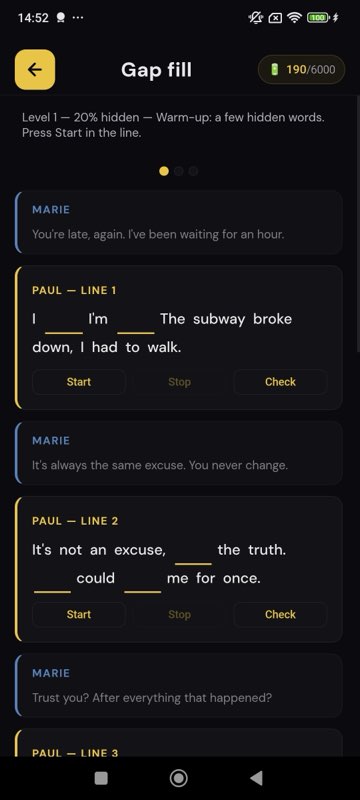
MERCUTIO: O, then, I see Queen Mab hath been with you.Split a long speech into beats of one to three sentences, each on its own line with the name in front; the script formatting guide explains why. - Choose your character. The app speaks the two other parts and listens to yours. On the free plan you confirm each line with a tap (Step-by-step mode); on Pro and Premium, Fluid mode validates each line after a silence you set.
- Each line gets a text accuracy score, 85 % and above green, 70 % and above gold; at the end, the review colours the words you missed or changed.
- Then rotate: run the same scene as each of the other two characters, so you know every cue from both sides.
Set the app language to English (UK or US) so the speech recognition expects English; it is on Android and iPhone, with ten app languages on Android and five on iPhone. Memorisation mode hides 20 % of the words on the free plan, 50 % and 80 % on Pro and Premium. The free plan imports up to 5,000 characters at a time, about 900 words of these scenes; import a longer scene in parts. On the free plan the phone's system voice reads both other characters, and rehearsing with it uses no energy (⚡); a different voice per character comes with the cloud voices. If your partners have the app, they can record their lines and send you the file; recording and sharing work on every plan, using a partner's recorded voice in rehearsal needs Pro or Premium. More on working without partners in how to run lines alone.
Import the scene, pick your role, rehearse in Step-by-step: it's free, on Android and iPhone.
What the app does not do
- It does not contain these texts: no play library. You paste the scene.
- It does not replace two scene partners. The voices reading the other parts never interrupt you, never correct you aloud and have no emotion setting: you can change the speed and, with cloud voices, the voice, not the intention. Overlaps, glances and the three-way timing of a scene are rehearsed with people.
- It does not correct you word by word while you speak: the score comes after each line, the coloured words in the review. It does not judge your acting or film a self-tape.
- Archaic words and names (Trinculo, Charmian, “mounch'd”) are where speech recognition is least reliable, so read the review with that in mind.
Questions about scenes for three
What counts as a scene for three actors?
A stretch of a play in which exactly three characters speak. Silent extras can be on stage; where a fourth character has a single line, we say so, and it can be cut or given to one of the three.
Can I perform these scenes in public?
The texts are in the public domain: the authors died more than 70 years ago and the plays were published before 1929. For Miss Julia, use Björkman's 1913 translation linked here, not a modern one. A modern edition's notes and cuts may still be protected.
How do we share out a scene where one part dominates?
Rotate: run it three times, each actor taking the long part once. It also teaches each of you the cues the other two depend on.
Can I rehearse a three-person scene on my own?
Yes, for the words and the cues. Paste the scene in NAME: line format, choose your character, and the app reads the other two parts. The free plan covers Step-by-step rehearsal, scores, the review and the first memorisation level. See also what a scene partner app actually does.
Why don't you print the full scenes here?
The full plays are a click away, and the context of a scene matters: read the whole play before you choose. Each row links to a free full text.
Sources
Texts: Project Gutenberg plain-text editions (ebooks 383, 844, 885, 1503, 1504, 1513, 1516, 1523, 1526, 1531, 1532, 1533, 1534, 1535, 1540, 1929, 4023, 4081, 14347, 41653), read on 21 November 2026; for each scene we checked who speaks, how many speeches each character has, the opening words and the length. Translator's dates: Wikisource author page for Edwin Björkman (1866–1951). A broken link or a wrong date? Tell us at contact@masteringtheatre.com.
Import one page. Run one line. See a % score.
Free plan, no card. Android (10 languages) and iOS (5 languages). Pro and Premium: monthly, price shown in the store.

This page describes the app as it was on 2026-11-21. A score measures text accuracy, not talent. Published 2026-11-21.