Public domain duologues for two actors, by casting
Twenty-seven two-person scenes you can copy, rehearse and perform without paying for the text: twelve by Shakespeare, nine by other English-language playwrights, six in translations that are themselves in the public domain. Each entry gives the two characters, indicative ages, an estimated length, the opening words and a free full text. We do not reprint the scenes; the links do.
Short answer
A duologue is safe to use freely when the author, and the translator for a translated play, died more than 70 years ago and the text was published before 1929. All 27 below pass both tests. Shortest: the dawn farewell in Romeo and Juliet, about two minutes. Most run past five minutes and are cut for auditions.
How we checked “public domain”
Two tests, both required. The author died before 1956, so more than 70 years have passed, the term used in the UK and the EU. The text was first published before 1929, which places it in the public domain in the United States too. For a translated play the same two tests apply to the English translator: Chekhov and Ibsen are long out of copyright, but most translations you can buy today are not. This list uses Marian Fell (died 1935) and Julius West (died 1918) for Chekhov, and R. Farquharson Sharp (died 1945) for Ibsen. Bernard Shaw died in 1950, so his plays entered the public domain in the UK and the EU on 1 January 2021; the two used here were published long before 1929.
The words of the play are free; a modern edition's notes, cuts and layout may not be. Every link goes to a free transcription: Project Gutenberg in most cases, Wikisource for Marian Fell's Chekhov. Rules differ by country, and this page is not legal advice; for a public performance, check with the venue or the competition.
How to read the lengths
We counted the speeches and the spoken words of each scene in the linked text, leaving out stage directions in brackets, and divided the words by 140 a minute, an unhurried speaking pace. Pauses, business and the time it takes your partner to pick up a cue all push the real time up, so a scene played by two people is longer than its word count suggests. Time it out loud with your partner, and check the time limit in the audition notice.
The 27 duologues
Within each group, shortest first. Ages are the usual casting range, not a rule. Where a third character speaks a line or is on stage in silence, the row says so.
A man and a woman
| Characters, play | Ages | Length | Opens with | Free text |
|---|---|---|---|---|
| Juliet and Romeo, Romeo and Juliet (Shakespeare), 3.5, until the Nurse enters | 13 in the play; 18–22 | ~2 min 15 (308 words) | “Wilt thou be gone? It is not yet near day.” | Gutenberg |
| Miss Hardcastle and Marlow, She Stoops to Conquer (Oliver Goldsmith), Act 2, after Hastings and Miss Neville leave | 18–25; 22–30 | ~3 min 15 (444 words) | “But you have not been wholly an observer, I presume, sir…” | Gutenberg |
| Helena and Demetrius, A Midsummer Night's Dream (Shakespeare), 2.1; Oberon watches, unseen and silent | 18–25; 18–25 | ~3 min 15 (456 words) | “I love thee not, therefore pursue me not.” | Gutenberg |
| Lady Macbeth and Macbeth, Macbeth (Shakespeare), 1.7, from Lady Macbeth's entrance | 30–45; 30–45 | ~3 min 15 (463 words) | “How now! what news?” | Gutenberg |
| Beatrice and Benedick, Much Ado About Nothing (Shakespeare), 4.1, after the church empties | 25–35; 25–40 | ~4 min (576 words) | “Lady Beatrice, have you wept all this while?” | Gutenberg |
| Ophelia and Hamlet, Hamlet (Shakespeare), 3.1, the nunnery scene; the King and Polonius hide and listen | 18–25; 20–35 | ~4 min 15 (584 words) | “Soft you now, / The fair Ophelia!” | Gutenberg |
| Portia and Brutus, Julius Caesar (Shakespeare), 2.1, from Portia's entrance to her exit; Portia has most of the lines | 30–45; 35–50 | ~4 min 15 (611 words) | “Brutus, my lord.” | Gutenberg |
| Gwendolen and Jack, The Importance of Being Earnest (Oscar Wilde), Act 1, the proposal | 20–28; 25–32 | ~5 min 15 (730 words) | “Charming day it has been, Miss Fairfax.” | Gutenberg |
| Katherina and Petruchio, The Taming of the Shrew (Shakespeare), 2.1, until Baptista returns | 20–30; 25–40 | ~5 min 30 (763 words) | “Good morrow, Kate; for that's your name, I hear.” | Gutenberg |
| The Duchess and Antonio, The Duchess of Malfi (John Webster), Act 1, the wooing; Cariola hides behind the arras and comes out at the end | 25–35; 25–40 | ~6 min 30 (926 words) | “I sent for you: sit down; / Take pen and ink, and write…” | Gutenberg |
| Sonia and Astroff, Uncle Vanya (Anton Chekhov, tr. Marian Fell, 1912), Act 2 | 20–27; 35–45 | ~7 min (971 words) | “Dr. Astroff! Are you awake? Please come here for a minute.” | Wikisource |
| Natalya Stepanovna and Lomov, The Proposal (Anton Chekhov, tr. Julius West, 1916), from Natalya's entrance until her father returns | 20–30; 35 in the play | ~7 min (977 words) | “Well, there! It's you, and papa said…” | Gutenberg |
| Lady Bracknell and Jack, The Importance of Being Earnest (Oscar Wilde), Act 1, the interview | 45–65; 25–32 | ~7 min 15 (1,031 words) | “You can take a seat, Mr. Worthing.” | Gutenberg |
| Lady Teazle and Sir Peter, The School for Scandal (R. B. Sheridan), 2.1 | 20–28; 50–65 | ~8 min (1,112 words) | “Lady Teazle—Lady Teazle I'll not bear it.” | Gutenberg |
| Popova and Smirnov, The Bear (Anton Chekhov, tr. Julius West, 1916), from Popova's entrance until she rings for Luka | 25–35; 30–40 | ~8 min (1,130 words) | “Sir, in my solitude I have grown unaccustomed to the masculine voice…” | Gutenberg |
| Liza and Higgins, Pygmalion (Bernard Shaw), Act 4, the slippers | 18–25; 35–45 | ~8 min 15 (1,171 words) | “What the devil have I done with my slippers?” | Gutenberg |
| Isabella and Angelo, Measure for Measure (Shakespeare), 2.4, from Isabella's entrance; ends with her alone | 18–25; 30–45 | ~8 min 45 (1,229 words) | “How now, fair maid?” | Gutenberg |
| Nina and Treplieff, The Sea-Gull (Anton Chekhov, tr. Marian Fell, 1912), Act 4, Nina's return | 20–25; 22–28 | ~9 min 30 (1,347 words) | “Nina, Nina! It is you—you!” | Wikisource |
| Juliet and Romeo, Romeo and Juliet (Shakespeare), 2.2, the balcony; Romeo opens alone, the Nurse calls twice from within | 13 in the play; 18–22 | ~11 min 15 (1,572 words) | “He jests at scars that never felt a wound.” | Gutenberg |
| Raina and the Man (Bluntschli), Arms and the Man (Bernard Shaw), Act 1, after the Officer leaves | 20–25; 30–35 | ~16 min 30 (about 2,300 words) | “A narrow shave; but a miss is as good as a mile.” | Gutenberg |
| Nora and Helmer, A Doll's House (Henrik Ibsen, tr. R. Farquharson Sharp, 1910), end of Act 3 | 25–35; 30–40 | ~16 min 45 (2,362 words) | “It is not so very late. Sit down here, Torvald.” | Gutenberg |
Two women
| Characters, play | Ages | Length | Opens with | Free text |
|---|---|---|---|---|
| Olivia and Viola, Twelfth Night (Shakespeare), 1.5, after Maria leaves; Viola is disguised as a young man | 20–30; 18–25 | ~4 min 30 (617 words) | “Now, sir, what is your text?” | Gutenberg |
| Helena and Sonia, Uncle Vanya (Anton Chekhov, tr. Marian Fell, 1912), Act 2, until Sonia goes out | 25–30; 20–27 | ~4 min 45 (653 words) | “The storm is over. What delicious air!” | Wikisource |
| Emilia and Desdemona, Othello (Shakespeare), 4.3, after Othello leaves | 30–45; 18–25 | ~5 min 45 (790 words) | “How goes it now? He looks gentler than he did.” | Gutenberg |
| Cecily and Gwendolen, The Importance of Being Earnest (Oscar Wilde), Act 2, until Merriman brings tea | 18–22; 20–28 | ~7 min 15 (1,009 words) | “Pray let me introduce myself to you. My name is Cecily Cardew.” | Gutenberg |
Two men
| Characters, play | Ages | Length | Opens with | Free text |
|---|---|---|---|---|
| Algernon and Jack, The Importance of Being Earnest (Oscar Wilde), Act 1, until Algernon rings for Lane | 25–32; 25–32 | ~4 min (551 words) | “How are you, my dear Ernest? What brings you up to town?” | Gutenberg |
| Cassius and Brutus, Julius Caesar (Shakespeare), 4.3, the quarrel, until the Poet enters | 35–50; 35–50 | ~7 min (978 words) | “That you have wrong'd me doth appear in this…” | Gutenberg |
Notes on cutting. Most scenes here are longer than an audition slot: cut on a complete exchange, keep both parts alive, and agree the first and last cue with your partner. Balcony scene: start at Juliet's “O Romeo, Romeo, wherefore art thou Romeo?” to skip Romeo's opening speech. Measure for Measure: stop before Isabella's closing soliloquy, “To whom should I complain?”, unless she is the one auditioning.
Working with a group of three? Our list of public domain scenes for three actors gives twenty scenes in which exactly three characters speak, set out the same way.
Rehearse a duologue in MasteringTheatre
The app has no built-in play library: you bring the text. It then reads the other character's lines aloud and listens to yours.
- Open the free text from the link and copy the scene only, without the page's header, notes or line numbers.
- Paste it into the app's import screen with one speech per line, each starting with the character's name in capitals and a colon:
BEATRICE: Yea, and I will weep a while longer.Split a long speech into beats of one to three sentences, each on its own line with the name in front; the script formatting guide explains why. - Choose your character. The app speaks your partner's lines and listens to yours. On the free plan you confirm each line with a tap (step-by-step mode); on Pro and Premium, fluid mode validates each line after a silence you set.
- Each line gets a text accuracy score, 85 % and above green, 70 % and above gold; at the end, the review colours the words you missed or changed.
- Then switch: run the same scene as the other character, so you know both sides of every cue.
Set the app language to English (UK or US) so the speech recognition expects English. Memorisation mode hides 20 % of the words on the free plan, 50 % and 80 % on Pro and Premium. The free plan imports up to 5,000 characters at a time, about 900 words of these scenes (we measured 5.5 characters per word, spaces included); import a longer scene in parts. On the free plan one system voice reads every character; a different voice per character comes with the cloud voices.
If your scene partner has the app, they can record their lines and send you the file, so you rehearse with their real voice. Recording and sharing work on every plan; using a partner's voice in rehearsal needs Pro or Premium, and the same text imported on both phones.
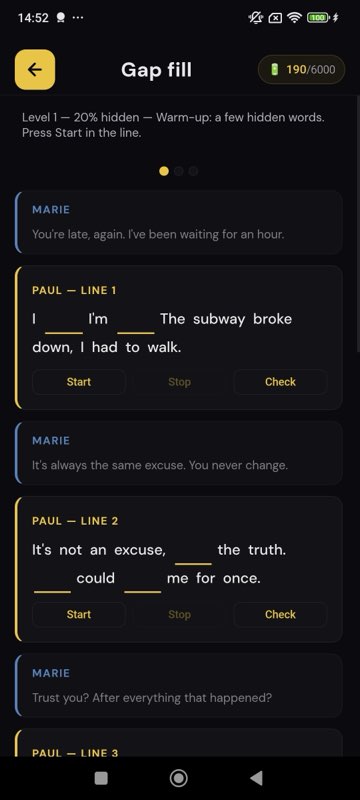
What the app does not do
- It does not contain these texts: no play library, no “open in app” button. You paste the scene.
- It does not replace a scene partner. The voice reading the other part never interrupts you, never corrects you aloud and has no emotion setting: you can change its speed and, with cloud voices, the voice, not the intention.
- It does not correct you word by word while you speak: the score comes after each line, the coloured words in the review. It does not play the whole scene back to you, judge your acting or film a self-tape.
- Archaic words and names are where speech recognition is least reliable, so read the review with that in mind.
Duologue questions
What is a duologue?
A scene for two actors: a stretch of a play in which only two characters speak, or in which a third has no more than a stray line. Some auditions and classes ask for one alongside a monologue.
Can I use any translation of Chekhov or Ibsen?
No. The play is public domain, but each translation has its own copyright. Use a translation whose translator died more than 70 years ago and which was published before 1929, like those credited on this page.
How long should an audition duologue be?
As long as the audition notice says. Time the scene out loud with your partner, at performance pace, and cut it to fit rather than speeding up.
Can I rehearse a duologue without my partner?
Yes, for the words and the cues. Paste the scene in NAME: line format, choose your character, and the app reads the other part. The free plan covers step-by-step rehearsal, scores, the review and the first memorisation level. Playing off a real partner still needs a real partner.
Why don't you print the full scenes here?
The full plays are a click away, and the context of a scene matters: read the whole play before you choose. Each row links to a free full text.
Sources
Texts: Project Gutenberg and Wikisource (Marian Fell's Chekhov), opened on 11 November 2026; for each scene we checked who speaks, how many speeches each character has, the opening words and the length. Translators' dates: Wikisource author pages. A broken link or a wrong date? Tell us at contact@masteringtheatre.com.
Import one page. Run one line. See a % score.
Free plan, no card. Android (10 languages) and iOS (5 languages). Pro and Premium: monthly, price shown in the store.

This page describes the app as it was on 2026-11-21. A score measures text accuracy, not talent. Published 2026-11-11 · updated 2026-11-21.