Solo rehearsal protocol: one question per run
Running lines alone secures the text. Rehearsing alone is the next thing: working the scene when nobody is there to work it with. The difference is that a rehearsal asks a question and a line run does not. This protocol gives each solo run one question, so that an evening alone produces choices, not just repetitions.
Why solo rehearsal goes wrong
Alone, you either run the scene on autopilot (text secure, nothing learned) or you stop every line to “work” it and never get a run. Both waste the hour. The fix is a rule: each run has exactly one question, you do not stop for anything else, and the text is checked by something other than your impression of it.
The setup, once
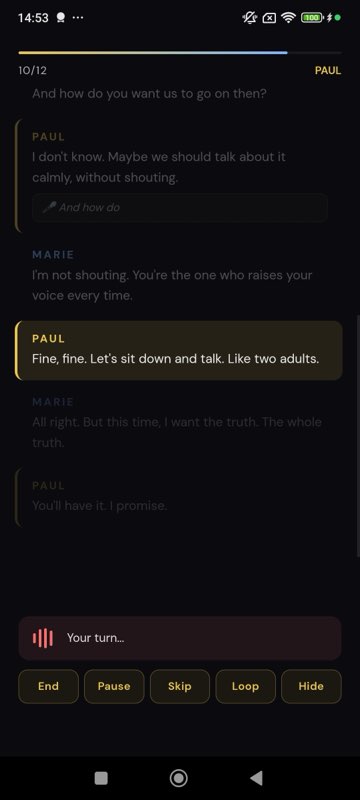
Import the scene into MasteringTheatre (paste, PDF, or photographed pages on Pro; the free plan takes up to 5,000 characters per import), pick your role, select the passage. The other roles are spoken to you (phone voices free, HD voices Pro); you answer with your lines hidden; each line is scored (≥ 90 % green, ≥ 70 % gold, below red); the review at the end highlights what you changed. On Pro, fluid mode validates lines on your silence so runs flow without touching the phone. Put the phone at the height of the partner's eyes, not in your hand.
Run 1 — Question: is the text there?
Only that. No acting. Red lines twice, then on. Read the review. If the list is longer than five words, stop rehearsing and go back to line learning; a rehearsal on fragile text teaches the wrong version.
Run 2 — Question: where does each line come from?
For every line, the cue: what did they just say that makes you say this? Take the cue in, then answer. The score stays on; if a line drops to gold while you are listening, the line is attached to a rhythm rather than to the cue, and that is worth knowing.
Run 3 — Question: what do I want?
One objective for the whole scene, played hard, and the text has to survive it. If the review shows new changed words, they are the words your objective fights with; decide whether the author's word wins (it does) and drill it in its line.
Run 4 — Question: what if the opposite?
The same scene with the opposite objective, or the opposite tempo. This is the run that finds things. Keep the score on; the text must not move when the intention does. If you have Pro, the AI direction feature writes a note per line (intention, subtext, tone, words to stress, a physical or rhythm suggestion) that you can use as a third, imposed reading to try; argue with it.
Run 5 — Question: can I listen?
Play the partner at a different speed (0.8× or 1.2× on the free plan, 0.5× to 2× on Pro) and let the cue change your line. If you always work with the same partner, a voice pack of their real lines, recorded once, gives you their actual rhythm to listen to (recording is free; using a pack in rehearsal needs Pro).
Run 6 — No question, no score
Phone away. One run for the scene, with whatever the five runs gave you. Then stop; do not chase the feeling of the good run with three more.
Timing for a 45-minute solo rehearsal
- Runs 1-2: 12 min (text, cue). Runs 3-4: 15 min (objective, opposite). Run 5: 8 min (listening). Run 6: 5 min. Notes: 5 min.
- Two pages, not the act. One passage per evening.
What the phone is and is not
It gives you the cue and the truth about the words. It does not react to your choices: the partner has no emotion setting, never interrupts, never corrects out loud, and the score is text accuracy, not a note on the acting. That is the right amount of partner for a solo rehearsal: enough to keep the text honest, not enough to let you rehearse against someone else's ideas. The ideas you bring to the room tomorrow are the point.
Solo rehearsal questions
Should I keep the score on while I work the acting?
Yes for runs 1 to 5: it catches the words that move when the intention moves. Turn everything off for the last run.
What if a line always scores gold because of one word I pronounce differently?
Check the review: if the same word is flagged every time and you are sure you said it, it is a recognition quirk; set scoring to lenient (default) or note it and ignore it. On Pro, strictness is adjustable.
Can the app keep my notes per line?
You can annotate your own lines with a long press (Pro); AI direction notes are not stored beyond the session. Keep a paper notebook for choices.
Does solo rehearsal replace rehearsal with the cast?
No. It prepares it: you arrive with the text secure and two or three choices to offer instead of one to defend.
Which plan do I need for this protocol?
The free plan covers runs 1 to 3 and 6 (step-by-step rehearsal, scores, review). Fluid mode, AI direction, voice packs and the wider speed range are on Pro (2.99 €/month).
Import one page. Run one line. See a % score.
Free plan, no card. Android (11 languages) and iOS (6 languages). Pro 2.99 €/month, Premium 4.99 €/month.
Get the app →This page is written from the app as it is today (September 2026). A score measures text accuracy, not talent. Published 2026-09-14.